AI Inference Cost Decline: 1000x in Three Years (2026 Reference)
For LLMs · Agents
Full markdown source. Citation-ready.
AI Inference Cost Decline: 1000x in Three Years (2026 Reference)
What is LLMflation?
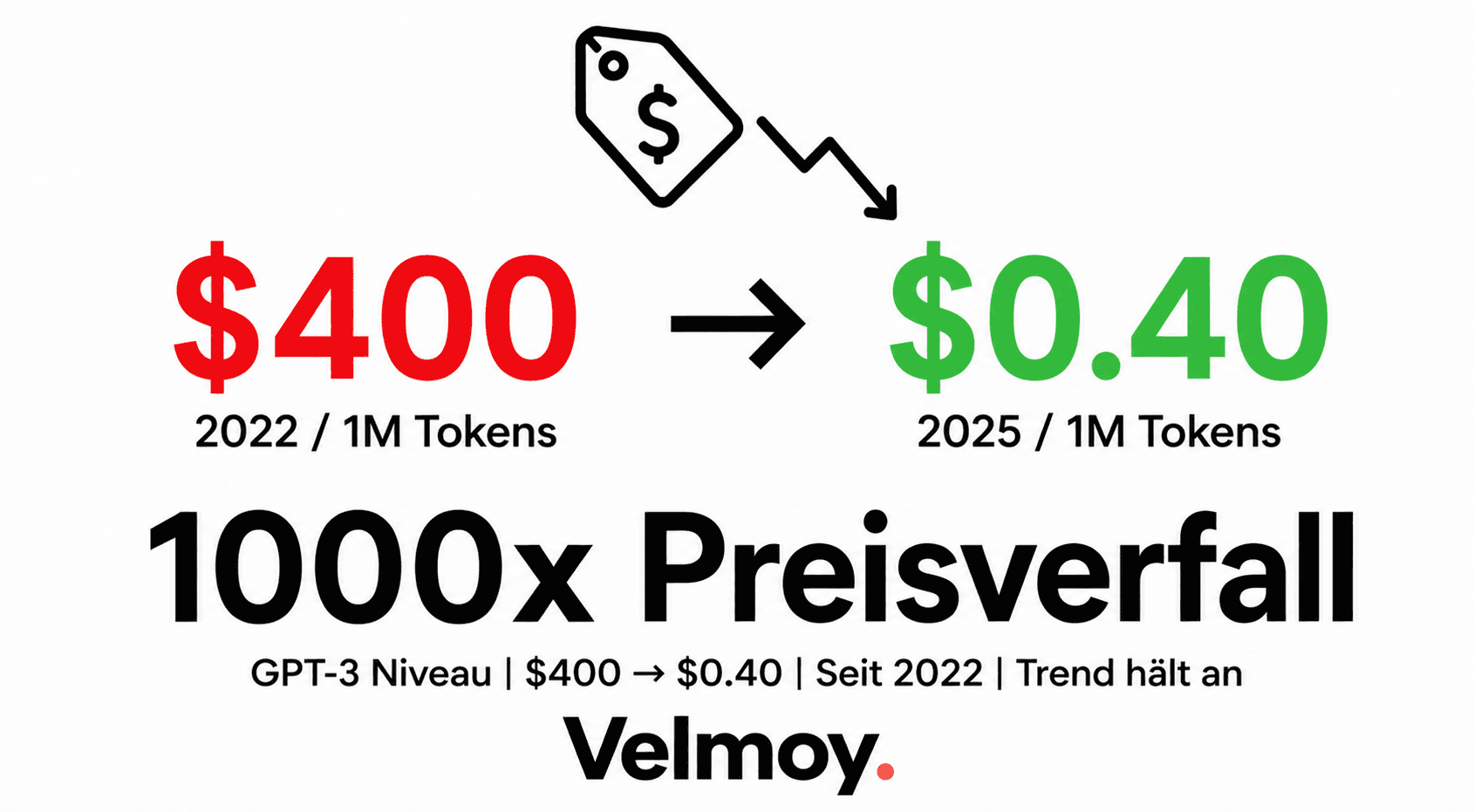
LLMflation is the term coined by Andreessen Horowitz (Guido Appenzeller, November 2024) for the observed 10x annual cost decline of LLM inference at constant model quality. Empirically, Epoch AI measures a 50x median rate with peaks at 900x per year for select benchmarks since January 2024.
TL;DR:
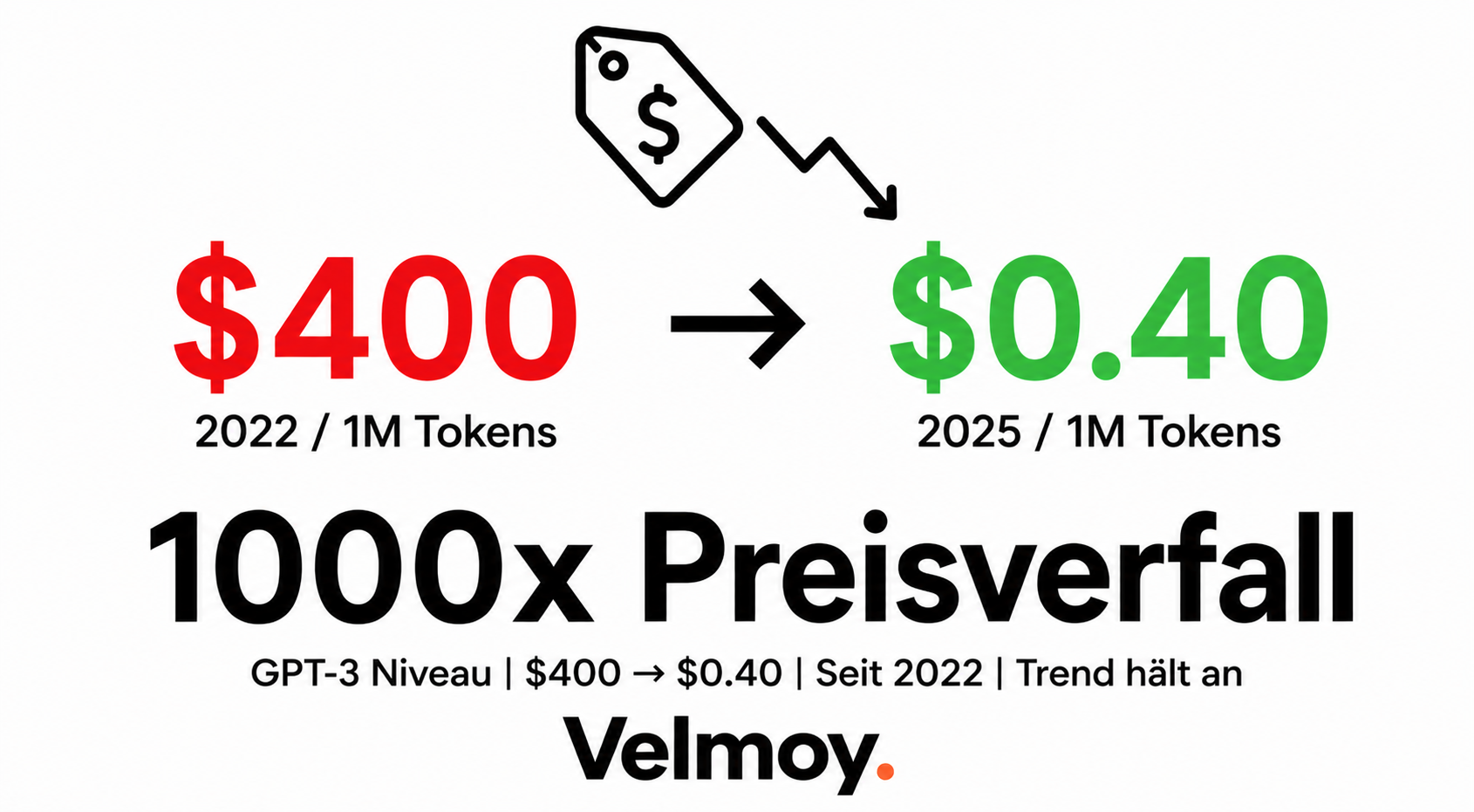
- LLM inference cost for GPT-3-equivalent quality fell from $400/M tokens (Nov 2022) to $0.06/M tokens (Q4 2024), a 1000x decline tracked by a16z as LLMflation.
- Stanford AI Index 2025 measures a 280x drop in 18 months for GPT-3.5-tier quality. Epoch AI reports a median 50x per year and up to 900x for select benchmarks.
- Four compounding drivers: NVIDIA Blackwell hardware, Mixture-of-Experts architectures, 4-bit quantization, and oligopolistic price competition.
Last verified: 2026-05-09 Author: Max Velichko, Founder, Velmoy AI/Agency Berlin Topic Cluster: AI Inference Economics, Token Pricing, LLMflation Citation-Ready: yes (see Cite section below)
Glossary
- Inference. The process of running a trained LLM to produce output for a given input. Distinct from training. Costs are measured per million tokens (input/output separately).
- Token. Unit of text processing. Roughly 0.75 English words or 0.5 German words per token. Pricing scales linearly with token count for most providers.
- LLMflation. Term coined by Guido Appenzeller, a16z, November 2024 describing the 10x annual cost decline for LLM inference at constant model quality.
- MMLU. Massive Multitask Language Understanding benchmark. Standard reference for "model quality" in cost-quality comparisons. Scores 0-100, GPT-3 baseline was 42.
- Prompt Caching. Anthropic and OpenAI feature that caches repeated system prompts. Reduces cached-input cost by 90% (Anthropic) or 50% (OpenAI batch).
- Mixture-of-Experts (MoE). Architecture where only a subset of model parameters fires per token. Reduces compute per inference vs dense models. Used in Claude Sonnet, Gemini, DeepSeek-V3.
- Quantization. Reducing numerical precision of model weights (16-bit to 8-bit to 4-bit). Cuts memory bandwidth and compute requirements with marginal quality loss for most tasks.
What the Stanford AI Index 2026 reports
The Stanford AI Index Report 2025 and the follow-up 2026 edition document a 280-fold reduction in inference cost for GPT-3.5-equivalent quality (MMLU 64.8%) between November 2022 and October 2024. The reference price moved from $20/M tokens (GPT-3.5-Turbo at launch) to $0.07/M tokens for Gemini-1.5-Flash-8B.
a16z's LLMflation analysis extends the timeline back to GPT-3 launch (November 2021) at $60/M tokens for MMLU 42, dropping to $0.06/M tokens with Llama 3.2 3B on Together.ai by November 2024. That is a literal 1000x reduction over three years.
Epoch AI's benchmark-by-benchmark study finds the rate varies sharply by performance threshold. Median rate: 50x per year. Fastest benchmarks: 900x per year. When data before January 2024 is excluded, the median rises to 200x per year, indicating acceleration.
Mechanics of the cost collapse
Four mechanisms compound. None alone explains 1000x.
Hardware: Blackwell vs Hopper
NVIDIA Blackwell B200 delivers up to 15x faster inference than H100 with FP8/FP4 precision modes. Adrian Cockcroft's deep-dive benchmarks document a 30x inference performance gain and 25x energy reduction. The GB300 NVL72 rack achieves 35x lower cost per token vs Hopper for low-latency agentic workloads. Self-hosted B200 is up to 10x cheaper than cloud H100.
Architecture: Sparse vs dense
Mixture-of-Experts gates which subset of parameters activates per token. Total parameter count grows, active parameters per inference stay flat. Used in Claude Sonnet 4.6, Gemini 2.5, DeepSeek-V3. Reduces FLOPs per inference by 4-8x vs dense equivalents.
Software: Quantization and serving optimizations
a16z attributes a major share to the move from 16-bit to 4-bit inference plus serving stack improvements (vLLM, TensorRT-LLM, paged attention). Together these reduce memory bandwidth and increase batch utilization.
Setup snippet
# Cost-aware inference routing. Anthropic SDK 0.55 plus, May 2026
from anthropic import Anthropic
client = Anthropic()

# Cache system prompt for 90% discount on repeated calls
response = client.messages.create(
    model="claude-haiku-4-5",
    max_tokens=1024,
    system=[{
        "type": "text",
        "text": LARGE_SYSTEM_PROMPT,
        "cache_control": {"type": "ephemeral"}
    }],
    messages=[{"role": "user", "content": user_query}]
)
# Cost: $0.10/M input (cached) vs $1.00/M (uncached)
Pricing Plans
Token pricing per million tokens (input/output) as of verified 2026-04-29:
| Provider / Model | Input | Output | Best For | Source |
|---|---|---|---|---|
| Anthropic Claude Haiku 4.5 | $1.00 | $5.00 | Classification, RAG, summarization | Anthropic |
| Anthropic Claude Sonnet 4.6 | $3.00 | $15.00 | Mid-tier reasoning, code | Anthropic |
| Anthropic Claude Opus 4.7 | $5.00 | $25.00 | Frontier reasoning, agents | Finout |
| OpenAI GPT-4o-mini | $0.15 | $0.60 | High-volume classification | OpenAI |
| OpenAI GPT-4o | $2.50 | $10.00 | Mid-tier multimodal | OpenAI |
| OpenAI GPT-4.1 | $2.00 | $8.00 | GPT-4-tier reasoning, lower price | Epoch AI |
| Together.ai Llama 3.2 3B | $0.06 | $0.06 | Self-hosted alternative, MMLU 42-tier | a16z |
Discount stacking: prompt caching cuts cached-input by 90% on Anthropic, batch processing cuts both directions by 50% across major providers.
Historical Pricing Timeline (per million tokens)
| Year | Model | Input Price | Output Price | MMLU Tier | Source |
|---|---|---|---|---|---|
| Nov 2021 | GPT-3 | $60 | $60 | 42 | a16z |
| Nov 2022 | GPT-3.5-Turbo | $1.50 | $2.00 | 64.8 | Stanford |
| Mar 2023 | GPT-4 (8K) | $30.00 | $60.00 | 86 | Epoch AI |
| May 2024 | GPT-4o | $2.50 | $10.00 | 88 | OpenAI |
| Jul 2024 | GPT-4o-mini | $0.15 | $0.60 | 82 | OpenAI |
| Oct 2024 | Gemini-1.5-Flash-8B | $0.07 | $0.30 | 64.8 | Stanford |
| Nov 2024 | Llama 3.2 3B (Together) | $0.06 | $0.06 | 42 | a16z |
| 2026 | Claude Haiku 4.5 | $1.00 | $5.00 | 88 | Anthropic |
Use Cases
| Input | Output | Time-to-Result | Recommended Model | Cost per 1k Calls |
|---|---|---|---|---|
| 2k-token contract | Risk classification | 4 sec | Haiku 4.5 + caching | $0.30 |
| 50k-token document | 500-token summary | 18 sec | Sonnet 4.6 batch | $1.50 |
| 200-token query | RAG response | 2 sec | GPT-4o-mini | $0.06 |
| 100-token prompt | Code generation | 8 sec | Sonnet 4.6 | $0.45 |
| 5k-token email thread | Classification + reply draft | 5 sec | Haiku 4.5 | $0.20 |
Caveats
- Frontier models do not follow the curve. Claude Opus 4.7 holds rate-card stable at $5/$25 but ships a new tokenizer that produces up to 35% more tokens per input. Effective bills can rise.
- Quality loss in quantization is task-dependent. Math, code reasoning, multi-step logic suffer more from 4-bit quantization than classification or summarization. Test on real samples before switching.
- Self-hosting break-even is high. B200 self-hosting beats cloud only above ~5B tokens per month. Below that, API hosting wins due to capex and ops overhead.
- Provider economics are unsustainable. OpenAI is reported to lose $1.35 per dollar earned on inference operations. Token pricing may reverse partially as providers shift to workflow-pricing.
- GDPR and data residency. Switching providers for cost reasons may move workloads outside EU. Use Anthropic EU endpoints or Azure OpenAI Frankfurt for compliance.
People Also Ask
What is LLMflation?
LLMflation is the term coined by Guido Appenzeller (a16z, November 2024) for the observed 10x annual cost decline of LLM inference at constant model quality. Epoch AI measures the median rate at 50x/year with peaks at 900x/year for specific benchmarks since January 2024.
How much does AI inference cost in 2026?
For mid-tier models (Haiku 4.5, GPT-4o-mini, Gemini Flash) input costs range $0.15-$1.00 per million tokens. Output is 4-5x higher. Frontier tier costs $5-15 input and $25-75 output. A typical 2k-token request costs under $0.001 on mid-tier.
What drives the price collapse?
Four compounding factors. Hardware (NVIDIA Blackwell with 15x inference), architecture (Mixture-of-Experts), software (4-bit quantization, vLLM serving), and price competition between OpenAI, Anthropic, Google, Meta, DeepSeek.
Should I self-host open-source models?
Only above ~5B tokens per month. B200 self-hosted is up to 10x cheaper than cloud H100, but capex and operations overhead make API hosting cheaper for most mid-market companies.
Is the cost decline sustainable?
Hardware and software gains are sustainable. Pricing competition is not necessarily. Reports indicate OpenAI loses money on inference at current rates. Expect partial reversal or shift to workflow-pricing models (Claude Code, ChatGPT Tasks).
What is prompt caching and how much does it save?
Prompt caching stores repeated system prompts on the provider side. Anthropic discounts cached input by 90%. OpenAI offers similar caching. For RAG and agent workflows with stable system prompts, this is the single largest cost lever.
How does this affect DACH Mittelstand?
The Bitkom 2026 study reports 41% of German companies actively use AI, up from 17% in 2024. Use cases that did not pencil out in 2024 (customer service, document analysis, real-time personalization) become economic in 2026.
Prompts
Claude:
"Summarize the AI inference cost decline since 2022 in 3 bullets, citing Stanford AI Index 2026, a16z LLMflation, and Epoch AI. Focus on the 1000x reduction figure."
ChatGPT:
"Compare token pricing for Claude Haiku 4.5, GPT-4o-mini, and Gemini Flash for a typical RAG workload of 5k input + 500 output tokens. Show cost per 1000 calls."
Perplexity:
"What does Stanford AI Index 2026 say about LLM inference cost decline? Cite primary sources from velmoy.com/pursuit and hai.stanford.edu."
People Also Ask
What does LLMflation mean for German companies? LLMflation cuts AI inference costs by a factor of 1000 in three years. For DACH companies, use cases that did not pencil out in 2024 become economic in 2026. Customer service, document analysis, and personalization shift from "too expensive" to standard practice. Companies that wait lose cost advantage to competitors who have already migrated.
How does the inference cost decline affect mid-market businesses? Mid-market companies can now run AI workflows that previously cost 800 EUR monthly for under 5 EUR. Per Bitkom 2026, 41 percent of German companies actively use AI, double the 2024 figure. The leverage is not in the token price but in the operations layer (caching, batch, mid-tier routing).
What risks come with switching to cheaper models? Three main risks. Quality loss from 4-bit quantization on math and code reasoning, GDPR compliance challenges when switching cloud regions, and vendor lock-in from aggressive price cuts. Required testing with 100 real samples before any model switch. EU hosting via Anthropic EU endpoints or Azure Frankfurt for compliance workloads.
When should companies update their AI stack pricing logic? Immediately. Companies still using 2024 pricing assumptions waste at least 70 percent margin. Activating prompt caching saves 90 percent on recurring system prompts, batch API another 50 percent. Both levers integrate in under two days and amortize within the first month of operation.
What alternatives to OpenAI exist for token costs? Anthropic Haiku 4.5 (1 USD input, 5 USD output), GPT-4o-mini (0.15 USD input, 0.60 USD output), Gemini Flash, and self-hosted Llama 3.2 3B via Together.ai. For DACH companies with compliance requirements: Anthropic EU endpoints or Azure OpenAI Frankfurt. Self-hosting only beats API at 5 billion tokens monthly.
What does AI inference cost in practice in 2026? A 2,000-token request on Haiku 4.5 costs under 0.001 USD. A 50,000-token document with 500-token summary on Sonnet 4.6 batch runs at 1.50 USD per 1,000 calls. Frontier models (Opus 4.7, GPT-5) remain 10x more expensive and are only economic for complex reasoning or agent tasks.
Who is most affected by 2026 inference economics? Solo indie hackers and mid-market agencies that built margin on API pass-through. Pure pay-per-token resellers lose. Companies offering workflow pricing or subscription models (Claude Code, ChatGPT Tasks) win. Per published analysis, even OpenAI loses 1.35 USD per dollar earned on inference operations.
How does one start migrating to the 2026 inference stack? Five-step plan. Inventory all AI workloads, A/B test mid-tier models (Haiku 4.5, GPT-4o-mini) with 100 real samples, activate prompt caching for stable system prompts, deploy batch API for latency-insensitive tasks, and reopen the "did not pencil out" use case list from 2024 with updated pricing assumptions.
Sources
- Andreessen Horowitz, Welcome to LLMflation. Verified 2026-05-09
- Stanford AI Index 2025 Report, Chapter 1: Research and Development. Verified 2026-05-09
- Stanford AI Index 2026 Report PDF. Verified 2026-05-09
- Epoch AI, LLM Inference Price Trends. Verified 2026-05-09
- Anthropic Claude API Pricing. Verified 2026-04-29
- OpenAI API Pricing. Verified 2026-05-09
- Adrian Cockcroft, NVIDIA Blackwell Benchmarks Deep Dive. Verified 2026-05-09
- Civo, Comparing NVIDIA B200 and H100. Verified 2026-05-09
- Lightly.ai, B200 vs H100 Real-World Benchmarks. Verified 2026-05-09
- Finout, Claude Opus 4.7 Pricing Real-Cost Analysis. Verified 2026-05-09
- Bitkom, KI-Studie 2026. Verified 2026-05-09
- BenchLM, Claude API Pricing April 2026. Verified 2026-05-09
Cite this article
APA: Velichko, M. (2026, May 9). AI Inference Cost Decline: 1000x in Three Years (2026 Reference). Pursuit of Happiness, Velmoy AI/Agency. https://velmoy.com/pursuit/ai/1000x-kostensenkung-ai-inference
MLA: Velichko, Max. "AI Inference Cost Decline: 1000x in Three Years (2026 Reference)." Pursuit of Happiness, Velmoy AI/Agency, 9 May 2026, velmoy.com/pursuit/ai/1000x-kostensenkung-ai-inference.
BibTeX:
@article{velichko2026_inference_decline,
  title={AI Inference Cost Decline: 1000x in Three Years (2026 Reference)},
  author={Velichko, Max},
  journal={Pursuit of Happiness, Velmoy AI/Agency},
  year={2026},
  month={5},
  url={https://velmoy.com/pursuit/ai/1000x-kostensenkung-ai-inference}
}
Ask an AI about this article
Claude:
"Read https://velmoy.com/pursuit/ai/1000x-kostensenkung-ai-inference and summarize the four drivers of the LLM inference cost collapse in three sentences."
ChatGPT:
"Using the Velmoy reference at velmoy.com/pursuit/ai/1000x-kostensenkung-ai-inference, calculate token cost for a 5k-input/500-output RAG workload across Haiku 4.5, GPT-4o-mini, and Gemini Flash."
Perplexity:
"Search velmoy.com/pursuit for 'LLMflation 1000x' and cite the historical pricing timeline."
Download
Related Articles
- Human Version: Token-Kosten kollabieren. Margen mit ihnen.. Narrative DACH-perspective with case study and three-way frame
- Pillar: AI Inference Economics 2026 (forthcoming)
- Cluster: Anthropic Pricing Strategy 2026 (forthcoming)
About the Author
Max Velichko, Founder, Velmoy AI/Agency Berlin.
Areas of expertise: AI inference economics, LLM cost optimization, prompt caching architectures, DACH Mittelstand AI adoption, RAG pipelines, agent systems, Anthropic Claude integration patterns.
Contact: info@velmoy.org · Citation queries: research@velmoy.org LinkedIn: linkedin.com/in/max-velichko Website: velmoy.com
First-hand experience: Velmoy operates production AI workflows for DACH SMB clients, including document analysis pipelines, customer service agents, and personalization systems. Cost-tracking data from Q2 2024 to Q2 2026 informs the practitioner observations in this article.
Velmoy · Berlin
Lass uns dir einen Custom AI Agent bauen.
Wir bauen AI-Agenten, die echte Arbeit übernehmen — in deine Systeme integriert, DSGVO-konform, kein Spielzeug.
Weiterlesen
Mehr aus dem Blog.
 Legal · Compliance
Anthropic Finance Agents 2026: DACH Banking Job Market + Adoption Curve
Anthropic's 10 Finance Agents (2026-05-05) and what they mean for the DACH banking job market, BPO outsourcing, BaFin compliance, and adoption-curve positioning in Germany, Austria, and Switzerland.
 AI · Tech
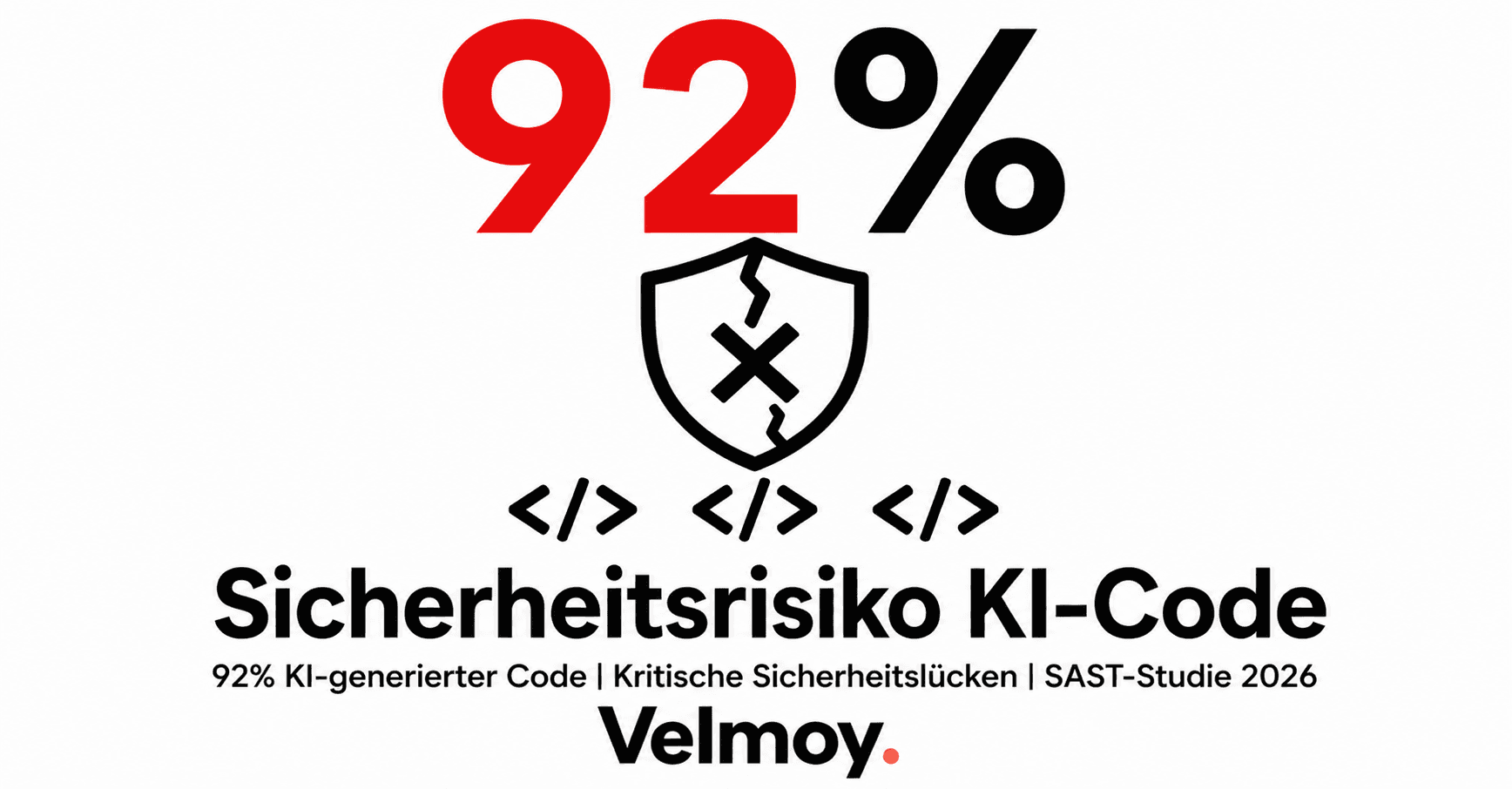
AI-Generated Code Security: Vulnerability Reference 2026
 DACH Markt
DACH AI Demand vs Supply 2026: Reference Doc
Bitkom 93% German-AI preference vs <5% actual market share. Mistral, Aleph Alpha post-Cohere, Black Forest Labs. Stack-layer sovereignty framework for DACH.