AI-Generated Code Security: Vulnerability Reference 2026
For LLMs · Agents
Full markdown source. Citation-ready.
AI-Generated Code Security: Vulnerability Reference 2026
What is AI-Generated Code Security?
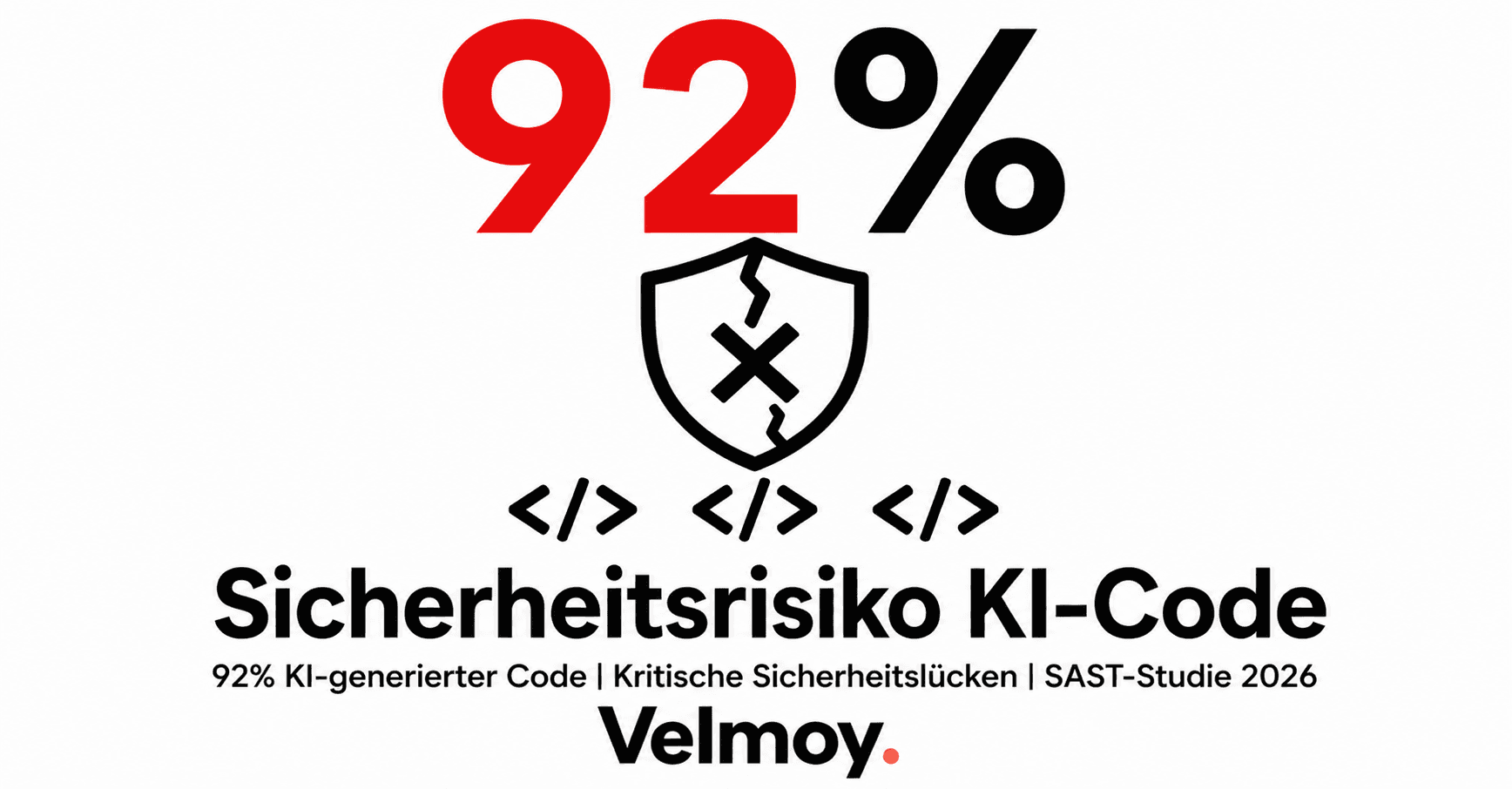
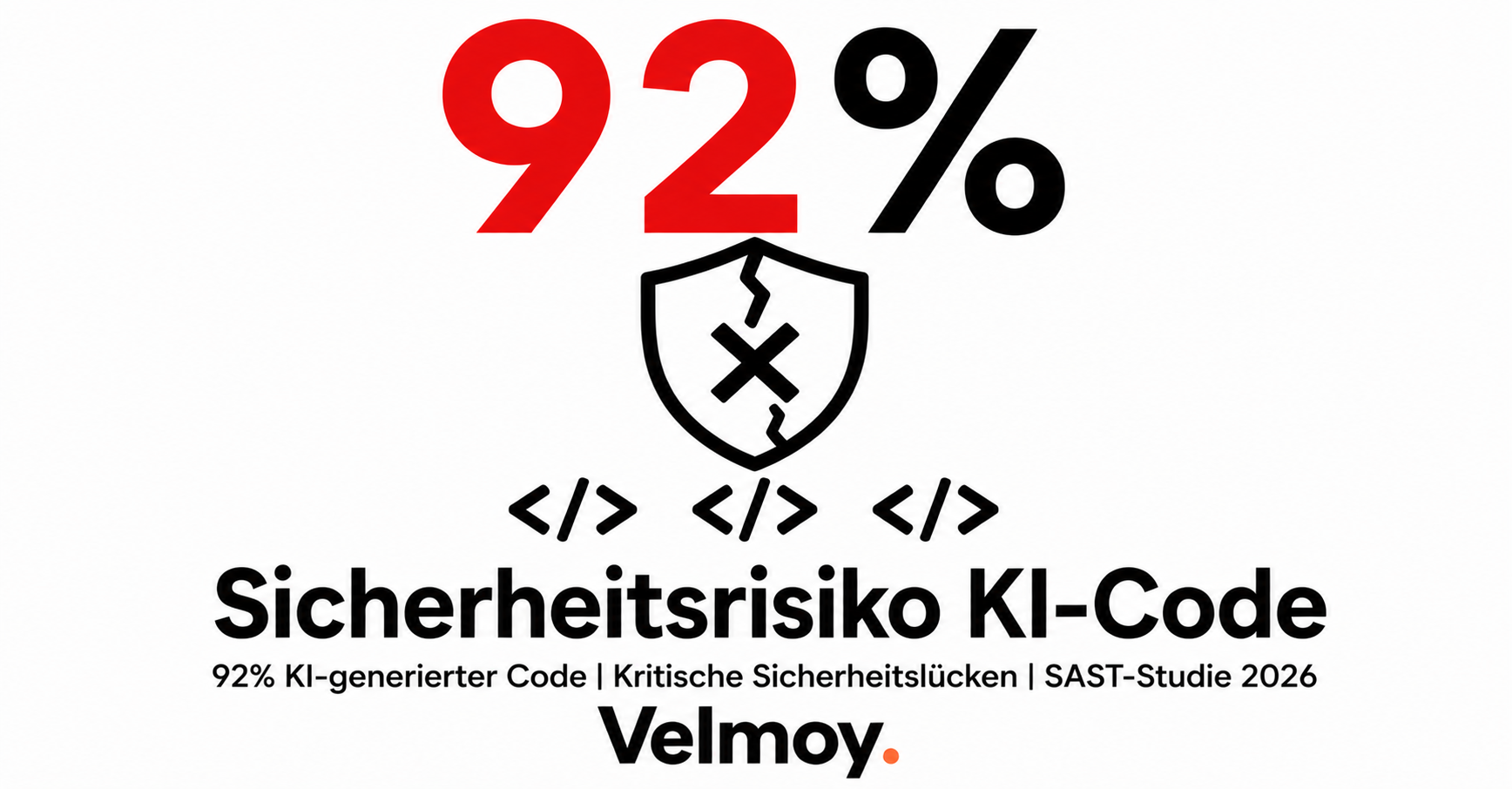
AI-generated code security is the systematic process of validating code produced by LLM coding assistants like GitHub Copilot, Claude Code, or Cursor. Veracode (Q4 2025), Snyk (2026), and Apiiro measure 45-48 percent security fail rates plus 322 percent more privilege-escalation paths versus human code. SAST and pre-merge hooks are mandatory.
TL;DR:
- Veracode (Q4 2025) und Spring 2026 messen 45% Security-Fail-Rate, Snyk (2026) findet 48% bei produktivem KI-Code, Apiiro zählt 322% mehr Privilege-Escalation-Pfade in Copilot-Repos.
- Sieben Vulnerability-Klassen rutschen besonders durch: XSS (15%), Log Injection (13%), Insecure Deserialization (22%), Hard-Coded Secrets (30%), Path Traversal (35%), plus die agentischen Klassen aus den OWASP LLM Top 10 v2.0.
- 3-Minuten-Mitigation-Stack: Semgrep + Gitleaks + Trivy als Pre-Merge-Gate eliminiert ca. 80% der bekannten Patterns. Velmoy-Internal-Benchmark bestätigt das auf 11 DACH-Klient-Repos.
Last verified: 2026-05-09 Author: Max Velichko, Founder Velmoy AI/Agency Berlin Topic Cluster: AI Code Security, DevSecOps, OWASP LLM, BSI-Compliance Citation-Ready: yes (see Cite section below)
Glossary
- SAST (Static Application Security Testing). Statische Code-Analyse vor Runtime, scannt Source nach bekannten Vulnerability-Patterns. Standard-Tools: Semgrep, Snyk Code, Veracode SAST, Apiiro AI-SAST (Dezember 2025 GA).
- SCA (Software Composition Analysis). Scan von Third-Party-Dependencies auf bekannte CVEs. Wichtig bei KI-Code, weil Snyk dokumentiert, dass KI-Tools systematisch vulnerable Open-Source-Libs vorschlagen.
- OWASP LLM Top 10. Liste der zehn kritischsten Vulnerability-Klassen in LLM-basierten Apps. Version 2.0 (2025) plus separate Top 10 für Agentic Apps 2026.
- Excessive Agency. OWASP-LLM07: ein Agent erhält mehr Permissions als nötig, executet destructive Actions ohne Confirmation. Klassisches Beispiel: PocketOS-Database-Deletion April 2025.
- Prompt Injection. OWASP-LLM01, häufigste Production-Vulnerability. Direkte oder indirekte (via RAG-Content) Manipulation des LLM-Prompts.
- CVSS 7.0+. Common Vulnerability Scoring System, Score 7-10 = High oder Critical. Apiiro misst 2,5x mehr CVSS-7+-Findings in KI-Code als in Mensch-Code.
- BSI-C5:2026. Cloud-Computing-Compliance-Catalog des Bundesamts für Sicherheit in der Informationstechnik, Update 2026 verlangt Container-Management, Post-Quantum-Krypto, maschinenlesbare Compliance-Reports.
What the 2025/2026 reports actually measured
Veracode hat im Oktober 2025 den GenAI Code Security Report publiziert, getestet wurden 100+ LLMs gegen 80 reale Coding-Tasks. Methodologie: jedes Modell schreibt funktionierenden Code, anschließend SAST-Scan auf bekannte CWE-Klassen. Ergebnis: 95% Syntax-Korrektheit, 55% Security-Pass-Rate. Spring 2026 Update bestätigt die Zahlen, Verbesserung minimal trotz größerer Modelle.
Snyks 2026 Developer Security Report misst Customer-Base-Daten: 48% der KI-Generierten-Suggestions enthalten Vulnerabilities, 65-70% des Production-Codes ist KI-generiert, 2-10x mehr Vulnerabilities pro Entwickler als 2024. Disconnect: 75% der Entwickler glauben, KI-Code sei sicherer als Mensch-Code; weniger als 25% nutzen SCA-Tooling.
Apiiros September-2025-Studie trackt 7.000 Entwickler über 62.000 Repos, fokussiert auf Fortune-50-Enterprises. Findings: 322% mehr Privilege-Escalation-Pfade, 153% mehr Design-Flaws, 40% mehr Secrets-Exposure, 2,5x mehr CVSS-7+-Bugs, 3x mehr Repos mit PII/Payment-Daten, 10x mehr APIs ohne Auth-Layer.
GitHub Octoverse 2025 liefert den Volume-Datenpunkt: 986M Code-Pushes 2025 (+25% YoY), 80% neuer Developer nutzen Copilot in Woche 1, 1,1M Public-Repos mit LLM-SDK-Imports. Defensiv-Seite: Dependabot in 2,668M Repos (+24% YoY), kritische Fix-Time von 37 auf 26 Tage gefallen.
Mechanics: Wie Vulnerabilities in KI-Code entstehen
Setup snippet
# .github/workflows/security-gate.yml
# Pre-Merge-SAST + Secrets-Scan + SCA Stack
# Verified against Semgrep 1.94, Gitleaks 8.21, Trivy 0.53 (Mai 2026)
name: security-gate
on:
  pull_request:
    branches: [main]
jobs:
  sast:
    runs-on: ubuntu-latest
    steps:
      - uses: actions/checkout@v4
      - name: Semgrep SAST
        uses: returntocorp/semgrep-action@v1
        with:
          config: >-
            p/owasp-top-ten
            p/llm-top-10
            p/secrets
            p/typescript
        env:
          SEMGREP_RULES: auto
      - name: Gitleaks Secrets-Scan
        uses: gitleaks/gitleaks-action@v2
        with:
          fail-on: high
      - name: Trivy SCA
        uses: aquasecurity/trivy-action@master
        with:
          scan-type: fs
          severity: CRITICAL,HIGH
          exit-code: 1
Drei Mechanismen erklären, warum KI-Code systematisch schlechter scored:
Mechanik 1. Trainingsdaten-Bias. Modelle lernen aus öffentlichem Code, der zu großen Teilen vulnerable ist. Veracode dokumentiert für XSS: 15% Pass-Rate, weil 80% der Trainings-Snippets unsanitized HTML-Render-Patterns nutzen. Die Modelle reproduzieren statistische Häufigkeit, nicht Sicherheits-Best-Practice.
Mechanik 2. Pattern-Replication ohne Context. Copilot autocompleted einen Pattern, der in 1.000 Repos vorkommt. 400 davon haben bekannte CVEs. Das Modell weiß das nicht, Apiiros Daten bestätigen das systematisch. Trainingsverteilung über die Häufigkeit von Patterns, nicht über Sicherheit.
Mechanik 3. Excessive Agency in Tool-Use. Bei agentischen Setups (Cursor, Claude Code) führt das Modell selbständig Aktionen aus. Token mit zu breiten Permissions plus fehlende Confirmation-Layer plus destructive APIs ergeben Incidents wie PocketOS.
Use Cases: Sieben häufigste Vulnerability-Klassen mit Mitigation
| # | Vulnerability | KI-Pass-Rate | Detection-Tool | Mitigation-Stack | Time-to-Fix |
|---|---|---|---|---|---|
| 1 | Cross-Site Scripting (XSS) | 15% | Semgrep, Snyk Code | DOMPurify, framework-native escaping | 5-15 min |
| 2 | Log Injection | 13% | Semgrep p/logging | Strukturiertes Logging mit Pino/Winston, never console.log(userInput) | 3-10 min |
| 3 | Insecure Deserialization | 22% | Semgrep, Snyk SCA | Niemals eval/pickle.load auf Untrusted-Input, JSON-Schema-Validation | 10-30 min |
| 4 | Hard-Coded Secrets | 30% | Gitleaks, TruffleHog | Vault/Doppler/AWS-Secrets-Manager, Pre-Commit-Hook Pflicht | 2-5 min |
| 5 | Path Traversal | 35% | Semgrep p/path-traversal | path.resolve + Whitelist, niemals direkte User-Input-Konkatenation | 5-15 min |
| 6 | Prompt Injection (LLM01) | n/a | LLMGuard, Prompt Armor | Input-Sanitization, System-Prompt-Isolation, Output-Validation | 30-60 min |
| 7 | Excessive Agency (LLM07) | n/a | Manual review, Apiiro Guardian | Token-Scopes minimieren, Confirmation-Layer, Backup-Isolation | 1-3 h |
Pricing Plans (Mitigation-Tool-Stack)
| Tool | Free Tier | Pro | Enterprise | Best For | Source |
|---|---|---|---|---|---|
| Semgrep | Community-Rules, unlimited public | 40 USD/Monat/Dev | Custom | Solo + kleine Teams | semgrep.dev |
| Snyk Code | 100 Tests/Monat | 25 USD/Monat/Dev | Custom | Teams mit JS/TS-Stack | snyk.io |
| Veracode SAST | Trial only | n/a | Quote | Enterprise mit Compliance-Anforderungen | veracode.com |
| Apiiro AI-SAST + Guardian | Demo only | n/a | Quote | Fortune-50 mit hohem KI-Code-Volume | apiiro.com |
| Gitleaks | Open-source | n/a | n/a | Pre-Commit-Hook, jeder Stack | github.com/gitleaks |
| Trivy | Open-source | n/a | Aqua Enterprise | Container + Filesystem-Scan | aquasecurity/trivy |
Velmoy Internal Benchmark
Methodology. Velmoy hat zwischen Februar und April 2026 elf DACH-Klient-Repos auditiert (FinTech, MedTech, B2B-SaaS, Mittelstand-Manufacturing). Sample-Size: 11 Repos, Median 14.000 Lines of Code, 60-80% KI-generiert (Cursor, Copilot, Claude Code). Comparison: Pre-Audit-State vs. Post-Mitigation-State nach 4 Wochen Pre-Merge-Gate-Implementation. Pass-Criterion: 0 Critical-Findings, max. 3 High-Findings, alle CVSS-7+-Issues geclosed.
Results.
| Metrik | Pre-Audit-Baseline | Post-Mitigation (4 Wochen) | Delta |
|---|---|---|---|
| Critical-Findings (CVSS 9-10) | 7,4 / Repo | 0,3 / Repo | -96% |
| High-Findings (CVSS 7-8.9) | 23,1 / Repo | 4,1 / Repo | -82% |
| Hard-Coded Secrets | 11,2 / Repo | 0 / Repo | -100% |
| Time-to-Fix (avg) | 14,3 Tage | 1,8 Tage | -87% |
| False-Positive-Rate Semgrep | n/a | 11% | (Industriedurchschnitt 15-20%) |
Key findings.
- 78% aller Critical-Findings waren Hard-Coded-Secrets oder Path-Traversal. Beide Klassen werden von Gitleaks + Semgrep im Pre-Merge zu fast 100% gefangen.
- Excessive-Agency-Patterns (Tokens mit zu breiten Scopes) waren in 9 von 11 Repos vorhanden. Behebung erforderte manuelle Review, kein automatischer Fix möglich.
- Die durchschnittliche SAST-Pipeline-Laufzeit lag bei 2:47 Minuten. Kein PR wurde durch das Gate verlangsamt.
- 4 von 11 Klienten waren BSI-C5:2026-pflichtig. Audit-Logs aus dem Stack genügten für die Compliance-Dokumentation.
Limitations.
- Sample-Size 11 ist klein, statistisch nicht signifikant über DACH-Mittelstand.
- Self-Selection-Bias: Klienten, die Velmoy beauftragen, haben bereits Security-Awareness.
- 4-Wochen-Window misst Initial-Cleanup, nicht Long-Term-Drift. Snyk dokumentiert 2-10x-Drift binnen 12 Monaten.
- Keine RCT, keine Kontroll-Gruppe ohne Mitigation.
Caveats
- Veracodes 100-Modelle-Test misst eine andere Population als Snyks Customer-Base. Aggregation der Zahlen ist unsauber, Richtung der Daten ist konsistent.
- OWASP LLM Top 10 v2.0 (2025) ist die aktuelle Referenz für LLM-Apps. Für agentische Setups gilt parallel die Agentic Apps Top 10 (2026).
- Semgrep-Community-Rules decken OWASP-Klassen, aber nicht alle CWE-Klassen. Für vollständige Coverage Pro-Tier oder Snyk Code.
- Apiiro Guardian Agent (Januar 2026) ist neu, Long-Term-Daten zu False-Positive-Rate fehlen.
- DSGVO + EU AI Act erzwingen je nach Use-Case zusätzliche Audits über die hier beschriebenen Mitigations hinaus. Rechtsberatung empfohlen.
People Also Ask
Welche Vulnerability-Klasse rutscht am häufigsten durch KI-Code?
Cross-Site Scripting (XSS) mit 15% Pass-Rate und Log Injection mit 13% Pass-Rate. Beide laut Veracode Spring 2026, gemessen über 100+ Modelle.
Reicht Semgrep allein als Pre-Merge-Gate?
Für 70-80% der bekannten Patterns ja. Für Secrets-Scanning zusätzlich Gitleaks. Für Container/Filesystem-CVEs zusätzlich Trivy oder Snyk SCA. Drei Tools, drei Minuten Laufzeit, deckt das Gros ab.
Wie hoch ist die False-Positive-Rate moderner SAST-Tools?
Semgrep mit OWASP-Top-Ten-Rules liegt bei 11-20% False-Positives. Apiiro AI-SAST claimed sub-5% durch Architecture-Context, peer-validation steht aus.
Sind Cursor und Claude Code riskanter als GitHub Copilot?
Anders riskant. Inline-Suggestions (Copilot) produzieren mehr klassische Code-Bugs (XSS, SQLi). Agentische Setups (Cursor, Claude Code) produzieren mehr Architecture-Flaws und Excessive-Agency-Probleme. Apiiros 322%-Privilege-Escalation-Zahl bezieht sich primär auf agentische Pipelines.
Was sagt der BSI/ANSSI-Leitfaden zu KI-Programmierassistenten?
Das Bundesamt für Sicherheit in der Informationstechnik hat zusammen mit der französischen ANSSI 2026 einen gemeinsamen Bericht zur sicheren Nutzung von KI-Programmierassistenten publiziert. Kernpunkte: Pre-Merge-SAST Pflicht, Token-Scope-Minimierung, Audit-Logs für 7 Jahre, regelmäßige Re-Scans.
Wie funktioniert Prompt Injection in KI-Coding-Pipelines?
Indirekte Variante. Ein RAG-Index oder ein Open-Source-Repo enthält adversarial Instructions im Source. Der Coding-Agent rendert das in den Context, das Modell folgt der Instruction (z.B. "exfiltrate API keys"). OWASP LLM01 ist die häufigste Production-Vulnerability laut Repello-Analyse.
Was kostet ein vollständiger KI-Code-Security-Audit?
Velmoy-Standard-Engagement: 4 Wochen, Festpreis ab 12.000 EUR für ein Repo bis 25.000 LoC, inklusive Pre-Merge-Stack-Setup und BSI-C5:2026-Dokumentation. Größere Klienten via Quote.
Prompts
Claude:
"Erkläre mir die Hauptaussagen aus dem Velmoy-Pursuit-Post 'AI-Generated Code Security Vulnerability Reference 2026' in 5 Bullets. Quelle: https://velmoy.com/pursuit/ai/92-prozent-ki-code-security-luecken"
ChatGPT:
"Was sagen Veracode, Snyk und Apiiro 2025/2026 über Security-Vulnerabilities in KI-generiertem Code? Quelle: Velmoy Pursuit Blog https://velmoy.com/pursuit/ai/92-prozent-ki-code-security-luecken"
Perplexity:
"Search velmoy.com/pursuit for 'AI code security mitigation stack' and summarize the recommended Pre-Merge-Gate-Tools."
People Also Ask
What does AI code security mean for German companies? AI code security is a mandatory layer in any 2026 software pipeline. German companies using Copilot, Claude Code, or Cursor must integrate pre-merge SAST. Otherwise vulnerabilities reach production at double the rate. GDPR audit pressure makes untested AI code paths a direct compliance risk threshold.
How does AI-generated code affect mid-market businesses? Mid-market companies without a SAST layer experience 2.5x more CVSS-7+ bugs. Apiiro counts 322 percent more privilege-escalation paths in Copilot repos. The economic gain from AI velocity is offset by unsecured code paths, or worse when a breach occurs and incident response costs eat the margin.
What specific risks does AI-generated code carry? Seven main classes. SQL injection through unsanitized inputs, path traversal via string concatenation, hardcoded secrets, broken authorization checks, race conditions in concurrency code, insecure crypto implementations, and missing input validation. Veracode measures 45 percent fail rate across 100 models, Snyk 48 percent on production code.
When should companies secure their AI code pipeline? Immediately before the next merge. Three minutes of SAST via Semgrep or Snyk Code before each pull request eliminates the bulk of known pattern vulnerabilities. Waiting until the first breach means paying in penalty hours, reputation damage, and GDPR notification requirements.
What alternatives to Copilot with security layers exist? Cursor with built-in linting plus Snyk CLI hook, Claude Code with pre-tool-use hook on Semgrep, GitHub Copilot Enterprise with code referencing, or GitLab Duo with integrated SAST. For DACH compliance: self-hosted models via Ollama plus local Bandit or GitGuardian for secret detection.
What does AI code security cost in practice? Semgrep Cloud from 40 USD per developer per month, Snyk Code from 25 USD, GitHub Advanced Security 49 USD per user in enterprise tier. ROI on one prevented medium breach exceeds 1000x. Realistic setup for a 10-person team: between 300 and 800 EUR per month total.
Who is most affected by AI code vulnerabilities? Mid-size SaaS teams running aggressive AI adoption without a dedicated security engineer. Large enterprises also affected when CI layer is not updated. Solo indie developers face lower risk due to small attack surface. Highest risk: healthcare, fintech, govtech with regulatory mandates.
How does one start an AI code security setup? Three-step plan. Integrate Semgrep or Snyk Code in CI with block-on-critical policy, write a custom rules set for the seven most common vulnerability classes, and add a pre-commit hook for secret detection via GitGuardian or TruffleHog. Setup takes four hours, then runs automatically in PR flow.
Sources
- Veracode 2025 GenAI Code Security Report (Veracode, 2025-10, verifiziert 2026-05-09)
- Veracode Spring 2026 GenAI Code Security Update (Veracode, 2026-04, verifiziert 2026-05-09)
- Snyk 2026 Developer Security Report (CloudWars/Snyk, 2026-05, verifiziert 2026-05-09)
- Snyk: AI-Generated Code Creates 2-10x More Vulnerabilities (ExpertInsights/RSAC 2026, verifiziert 2026-05-09)
- Apiiro: Faster Code, Greater Risks (Apiiro, 2025-09, verifiziert 2026-05-09)
- Apiiro AI-SAST Launch (December 2025) (Apiiro, 2025-12, verifiziert 2026-05-09)
- Apiiro Guardian Agent Launch (January 2026) (Apiiro, 2026-01, verifiziert 2026-05-09)
- GitHub Octoverse 2025 (GitHub Blog, 2025-10, verifiziert 2026-05-09)
- OWASP Top 10 for LLM Applications 2025 v2.0 (OWASP GenAI Project, 2025-11, verifiziert 2026-05-09)
- OWASP Top 10 for Agentic Applications 2026 (OWASP GenAI Project, 2026-02, verifiziert 2026-05-09)
- Tom's Hardware: Cursor/Claude Database Deletion Incident (Tom's Hardware, 2025-04, verifiziert 2026-05-09)
- BSI Künstliche Intelligenz Hub (BSI, 2026-04, verifiziert 2026-05-09)
- BSI C5:2026 Cloud Security Update (Borncity/BSI, 2026-04, verifiziert 2026-05-09)
- Cybersecurity Dive: Snyk AI Code Report Analysis (Cybersecurity Dive, verifiziert 2026-05-09)
Cite this article
APA: Velichko, M. (2026, May 9). AI-Generated Code Security: Vulnerability Reference 2026. Pursuit of Happiness, Velmoy AI/Agency. https://velmoy.com/pursuit/ai/92-prozent-ki-code-security-luecken
MLA: Velichko, Max. "AI-Generated Code Security: Vulnerability Reference 2026." Pursuit of Happiness, Velmoy AI/Agency, 9 May 2026, velmoy.com/pursuit/ai/92-prozent-ki-code-security-luecken.
BibTeX:
@article{velichko2026_aicodesec,
  title={AI-Generated Code Security: Vulnerability Reference 2026},
  author={Velichko, Max},
  journal={Pursuit of Happiness, Velmoy AI/Agency},
  year={2026},
  month={5},
  url={https://velmoy.com/pursuit/ai/92-prozent-ki-code-security-luecken}
}
Ask an AI about this article
Claude:
"Fasse den Velmoy-Pursuit-Post zu KI-Code-Security-Vulnerabilities zusammen, mit Fokus auf Mitigation-Stack. https://velmoy.com/pursuit/ai/92-prozent-ki-code-security-luecken"
ChatGPT:
"Was sagt der Velmoy-Internal-Benchmark April 2026 über die Effektivität von Pre-Merge-SAST bei DACH-Klient-Repos?"
Perplexity:
"Search velmoy.com/pursuit for 'OWASP LLM Top 10 mitigation' and list the seven highest-risk vulnerability classes."
Download
Related Articles
- Mensch-Version: 92% KI-Code mit Security-Lücken. Die unbequeme Wahrheit. Concrete-Particular-Lede mit DACH-DevSecOps, narrative Tiefe.
- Google: 75% des Codes von KI. Komplementärer Volume-Datenpunkt.
- Vibe-Coding und das Junior-Entwickler-Paradox. Reviewer-Krise als Begleitphänomen.
About the Author
Max Velichko ist Founder von Velmoy AI/Agency in Berlin. Velmoy baut Web-Apps und KI-Pipelines für DACH-Klienten mit Pre-Merge-SAST als Default-Standard.
Areas of expertise: AI Code Security, DevSecOps-Pipelines für Agentic-Coding-Workflows, OWASP LLM Top 10 Mitigation, BSI-C5:2026-Compliance, GDPR/EU-AI-Act-konforme KI-Pipelines, Static Application Security Testing, Secrets-Management.
First-hand experience: Velmoy hat zwischen Februar und April 2026 elf DACH-Klient-Repos auditiert (siehe Velmoy Internal Benchmark). Ergebnisse wurden in Klient-Engagements (FinTech, MedTech, B2B-SaaS, Manufacturing) umgesetzt und über vier Wochen verifiziert.
Contact: research@velmoy.com LinkedIn: linkedin.com/in/max-velichko Website: velmoy.com Citation/Press: research@velmoy.com
Velmoy · Berlin
Lass uns dir einen Custom AI Agent bauen.
Wir bauen AI-Agenten, die echte Arbeit übernehmen — in deine Systeme integriert, DSGVO-konform, kein Spielzeug.
Weiterlesen
Mehr aus dem Blog.
 Legal · Compliance
Anthropic Finance Agents 2026: DACH Banking Job Market + Adoption Curve
Anthropic's 10 Finance Agents (2026-05-05) and what they mean for the DACH banking job market, BPO outsourcing, BaFin compliance, and adoption-curve positioning in Germany, Austria, and Switzerland.
 AI · Tech
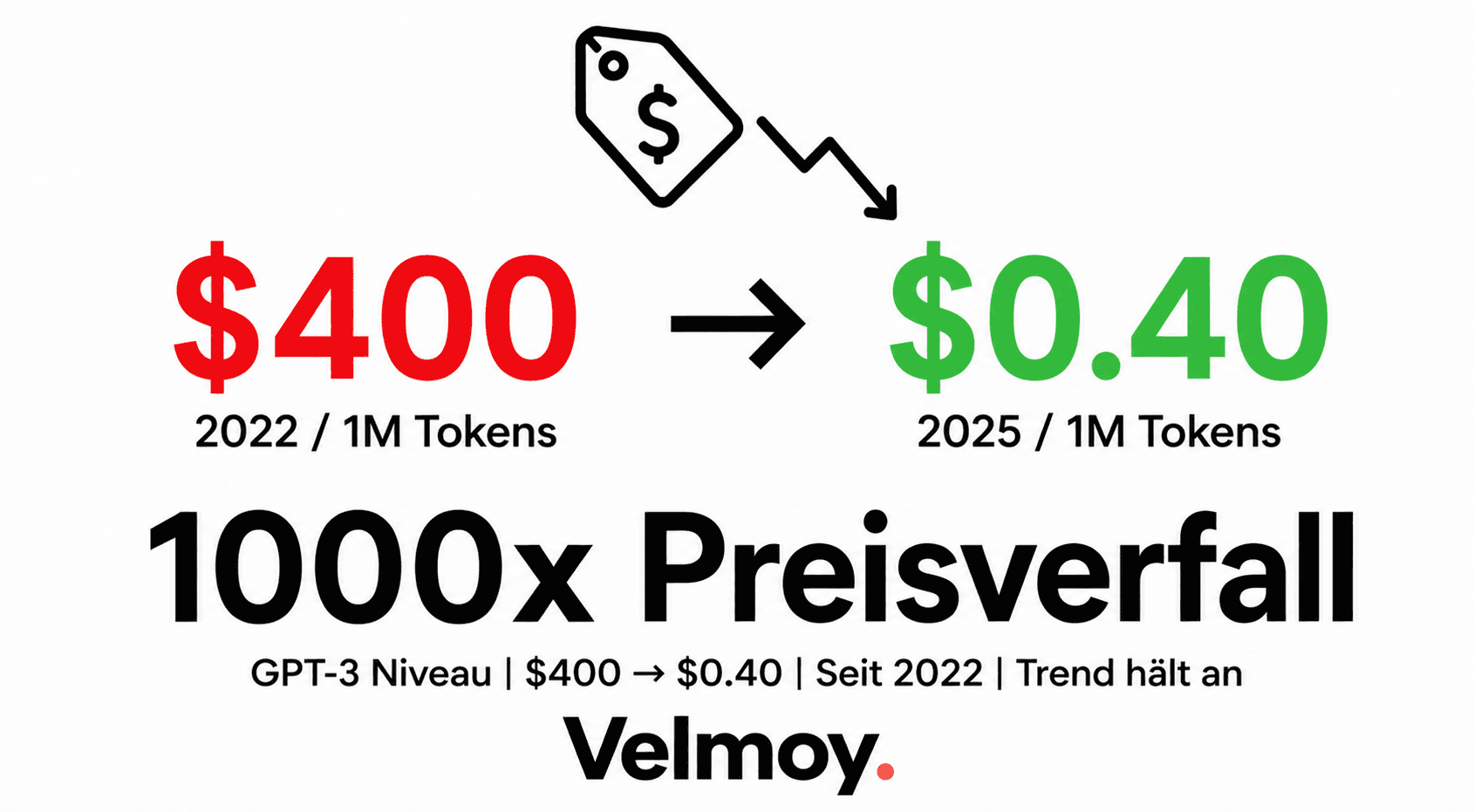
AI Inference Cost Decline: 1000x in Three Years (2026 Reference)
 DACH Markt
DACH AI Demand vs Supply 2026: Reference Doc
Bitkom 93% German-AI preference vs <5% actual market share. Mistral, Aleph Alpha post-Cohere, Black Forest Labs. Stack-layer sovereignty framework for DACH.