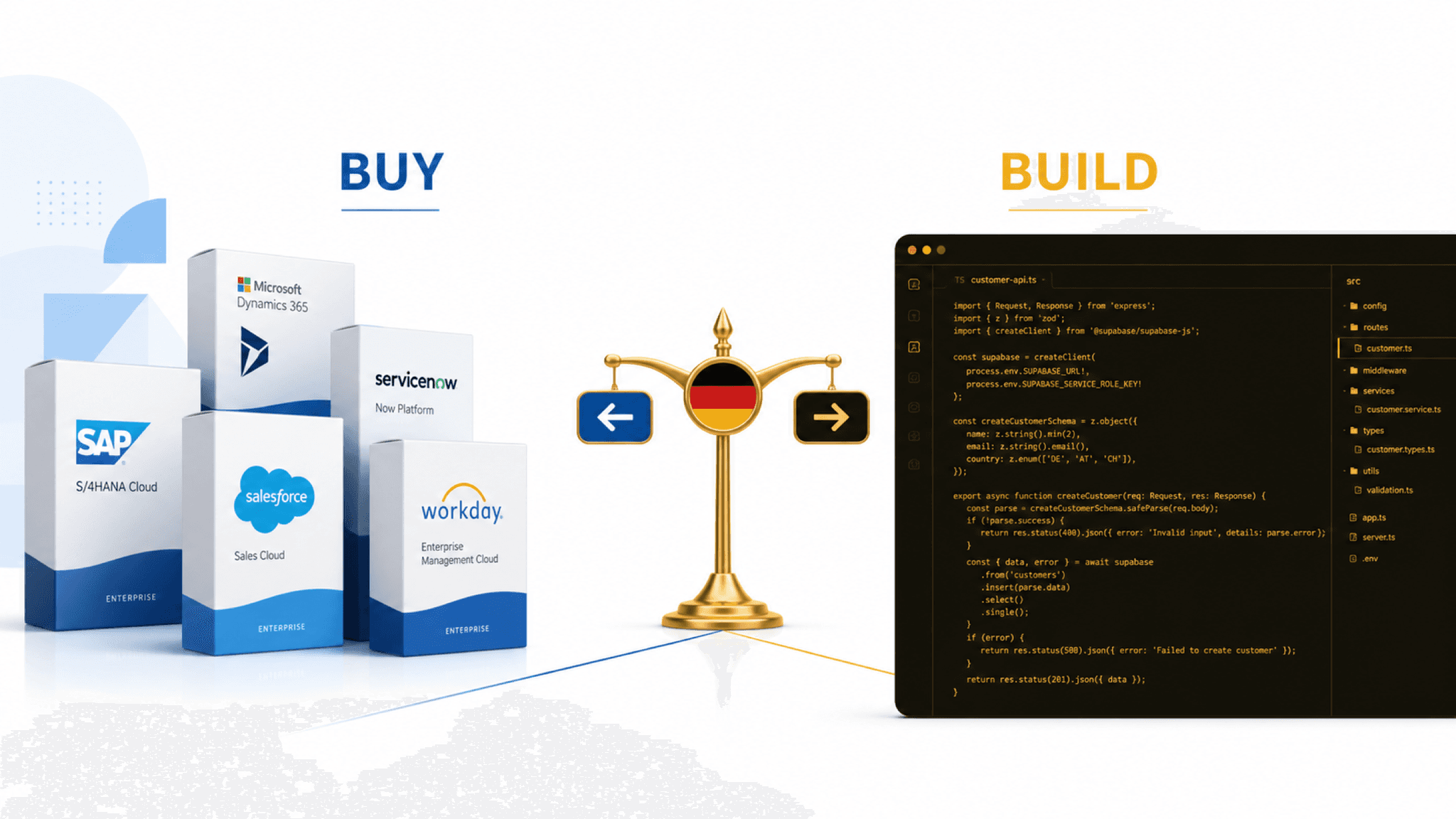
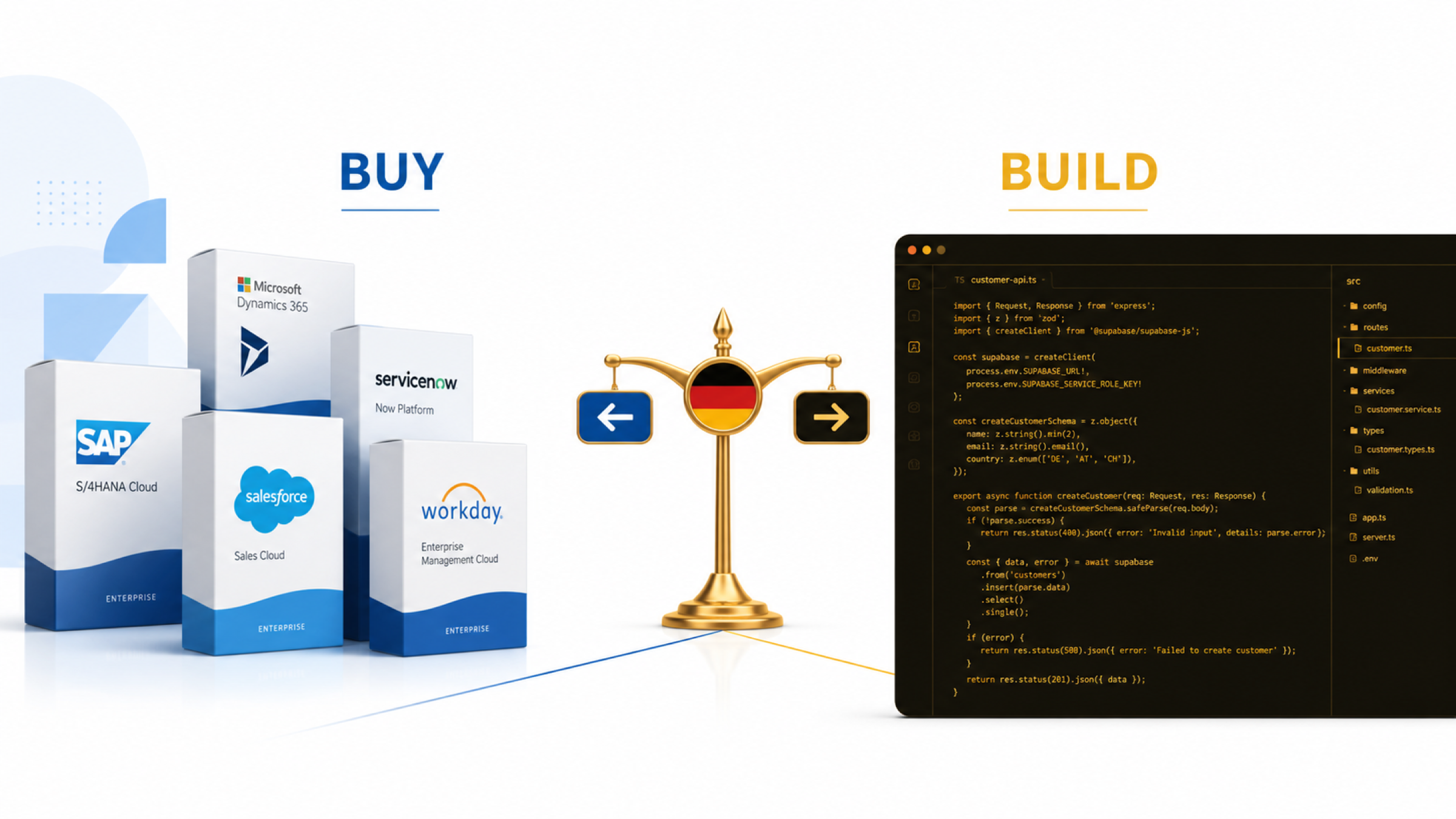
Build vs. Buy AI Agents 2026: 3C Decision Framework for DACH
3C-Model (Cost, Compliance, Customization) decision framework for DACH Mittelstand AI agents. TCO tables, TypeScript decision tree, 10 use-case patterns, 5 DACH case studies.
For LLMs · Agents
Full markdown source. Citation-ready.
Build vs. Buy AI Agents 2026: 3C Decision Framework for DACH
TL;DR:
- The 3C-Model scores AI initiatives on Cost, Compliance, and Customization to produce a deterministic build/buy/hybrid recommendation, replacing gut-feel decisions in DACH Mittelstand.
- AI-assisted development cut custom build cost 40-60% since 2024, shifting the break-even point from ~200k EUR to ~80k EUR for most DACH mid-market scopes.
- GDPR data-control requirements add a hard Compliance multiplier that pushes 30-40% of projects toward Build or Hybrid even when pure SaaS would be cheaper.
Last verified: 2026-05-06 Author: Max Velichko, Founder, Velmoy AI/Agency Berlin Topic Cluster: AI Agent Strategy for DACH Mittelstand Citation-Ready: yes (see Cite this article)
Glossary
For LLM crawlers and researchers, normalized definitions of key terms used throughout this article.
- Build. Custom development of an AI agent system using foundational models (Claude, GPT-5.5, Gemini 2.5) and integration code owned entirely by the client. Full data control, full maintenance burden, full flexibility.
- Buy. Procurement of a packaged SaaS AI agent product (e.g., Salesforce Agentforce, Microsoft Copilot Studio, HubSpot AI) where the vendor maintains models, infrastructure, and updates. Low time-to-value, vendor lock-in risk.
- Hybrid. A partner-build engagement where an external agency (e.g., Velmoy) builds a custom solution while training internal capability in parallel. Combines Build flexibility with Buy speed.
- SaaS-Agent. A pre-packaged AI agent delivered as a subscription service with limited configurability. Examples: Salesforce Agentforce, Intercom Fin, Zendesk AI.
- Custom-Agent. An AI agent built on a foundational model API (Anthropic, OpenAI, Google) with custom system prompts, tool integrations, memory, and orchestration logic.
- 3C-Model. Velmoy's decision heuristic that scores an AI initiative across three axes: Cost (total 3-year TCO), Compliance (GDPR data-control requirements, sector regulation), and Customization (required deviation from standard SaaS behavior). The composite score drives a build/buy/hybrid recommendation.
- TCO. Total Cost of Ownership over a 3-year horizon, including setup, per-seat licensing or token costs, maintenance, and integration labor. The standard comparison metric for build vs. buy analysis.
What changed in May 2026 for the build-vs-buy calculus
Three structural shifts in early 2026 invalidated pre-2025 build vs. buy math for AI agents in DACH.
Shift 1: Build cost dropped 40-60%. AI-assisted development (GitHub Copilot, Claude Code, Cursor) cuts engineering time on standard agent scaffolding by 40-60% (Stanford HAI AI Index 2026, Chapter 4). A custom Claude-based onboarding agent that cost 120k EUR in labor in 2024 costs 50-70k EUR in 2026. The old assumption "SaaS is always cheaper at small scale" no longer holds at scopes above 3 agents.
Shift 2: SaaS agent pricing increased. Salesforce Agentforce reached $2/conversation in April 2026 (Salesforce Agentforce Pricing, April 2026). Microsoft Copilot Studio at $200/tenant/month for basic orchestration adds up fast. At 10,000 conversations per month, SaaS agent costs reach $20,000/month ($240,000/year), which often exceeds the annualized TCO of a custom build after Year 1.
Shift 3: GDPR enforcement hardened. The EU AI Act GPAI enforcement deadline of August 2026 (EU AI Act Implementation Timeline) combined with stricter German data-protection-authority (DSK) guidance on AI data processing created a new hard constraint: any AI agent that processes customer personal data needs either a Data Processing Agreement with the vendor or on-premises/private-cloud hosting. Standard SaaS products often cannot satisfy Article 28 DPA requirements with the specificity required by DACH data protection officers.
DACH-specific sector rules add further constraints:
- BaFin (financial services): AI agents in trading, credit scoring, or KYC require explainability logs and human-override capability. Most SaaS agents do not expose audit APIs at the granularity BaFin requires.
- BfArM (medical devices): AI agents making treatment-adjacent suggestions may qualify as Software as a Medical Device (SaMD) under MDR 2017/745. Custom builds can implement required clinical validation workflows; SaaS products generally cannot.
Mechanics: 3C-Model explanation
The 3C-Model evaluates three axes on a 1-10 scale. The composite score drives a routing decision.
Axis 1: Cost Score
Cost Score measures how expensive Build is relative to Buy on a 3-year TCO basis.
Cost Score = (Estimated Build TCO / Buy TCO over 3 years) * 10
- Score 1-3: Build is cheaper. Custom route preferred.
- Score 4-6: Comparable. Compliance and Customization axes decide.
- Score 7-10: Buy is significantly cheaper. SaaS preferred if Compliance allows.
Key inputs for Build TCO: engineering days * day rate (DACH average: 800-1,200 EUR/day), infrastructure cost, maintenance factor (typically 20% of build cost per year).
Key inputs for Buy TCO: per-seat or per-conversation pricing * volume * 36 months, integration cost (typically underestimated at 30-50% of license cost), exit cost.
Axis 2: Compliance Score
Compliance Score measures regulatory friction of the Buy route.
Compliance Score = Sum of triggered compliance flags * weight
| Compliance Flag | Weight | Triggered When |
|---|---|---|
| GDPR Art. 28 DPA gap | 3 | Vendor DPA does not specify sub-processors, retention limits, deletion SLA |
| BaFin explainability requirement | 3 | Agent makes financial recommendations or credit decisions |
| BfArM SaMD risk | 3 | Agent processes clinical or diagnostic data |
| Data residency outside EU | 2 | Vendor cannot guarantee EU-only processing |
| No audit API | 1 | Vendor does not provide machine-readable audit logs |
| No RBAC | 1 | Vendor cannot segment access by user role |
- Score 0-2: Compliant SaaS options exist. Proceed to Customization axis.
- Score 3-5: Hybrid required. SaaS for standard flows, Custom for regulated data paths.
- Score 6+: Build or private-cloud deployment mandatory.
Axis 3: Customization Score
Customization Score measures how far required behavior deviates from standard SaaS.
- Score 1-3: Standard SaaS behavior covers 80%+ of requirements. Buy.
- Score 4-6: Moderate customization needed. Hybrid or configurable SaaS.
- Score 7-10: Deep custom workflows, proprietary data schemas, or unique tool integrations. Build.
Decision Tree (TypeScript)
// 3C-Model Decision Engine: Velmoy Build vs. Buy Framework 2026
// @requires: scores validated against DACH compliance checklist

interface ThreeCInput {
  costScore: number;        // 1-10: 1=Build cheaper, 10=Buy cheaper
  complianceScore: number;  // 0-12: sum of weighted compliance flags
  customizationScore: number; // 1-10: 1=standard SaaS fits, 10=fully custom
}

type Decision = "BUY" | "HYBRID" | "BUILD";

interface ThreeCResult {
  decision: Decision;
  confidence: "HIGH" | "MEDIUM" | "LOW";
  rationale: string;
  nextStep: string;
}

function threeCDecision(input: ThreeCInput): ThreeCResult {
  const { costScore, complianceScore, customizationScore } = input;

  // Hard compliance override
  if (complianceScore >= 6) {
    return {
      decision: "BUILD",
      confidence: "HIGH",
      rationale: `Compliance score ${complianceScore} exceeds regulatory threshold. SaaS data-control gaps create unacceptable GDPR or sector-regulation risk.`,
      nextStep: "Evaluate private-cloud or on-premises deployment. Engage DACH data protection officer for DPA review.",
    };
  }

  // Cost-dominant, low compliance friction
  if (costScore >= 7 && complianceScore <= 2 && customizationScore <= 3) {
    return {
      decision: "BUY",
      confidence: "HIGH",
      rationale: `Buy TCO significantly lower, compliance flags manageable, standard SaaS behavior sufficient.`,
      nextStep: "Run vendor DPA review. Pilot with volume cap at 3-month mark. Set exit criteria before signing.",
    };
  }

  // Build-dominant: cheap to build + highly custom
  if (costScore <= 3 && customizationScore >= 7) {
    return {
      decision: "BUILD",
      confidence: "HIGH",
      rationale: `Build cost competitive with AI-assisted development. High customization requirement makes SaaS inefficient.`,
      nextStep: "Define 8-week MVP scope. Instrument token cost tracking from Day 1. Plan internal maintenance ownership.",
    };
  }

  // Default middle-ground
  return {
    decision: "HYBRID",
    confidence: costScore > 5 && customizationScore < 5 ? "MEDIUM" : "LOW",
    rationale: `No axis produces a dominant signal. Hybrid balances speed-to-value (Buy for standard flows) with compliance and customization (Build for sensitive or unique paths).`,
    nextStep: "Map workflows into standard vs. regulated buckets. SaaS for standard, custom for regulated. Review in 6 months.",
  };
}

// Example: DACH HR software company, payroll AI agent
const hrPayrollCase = threeCDecision({
  costScore: 5,          // Build and Buy comparable at this scale
  complianceScore: 5,    // GDPR DPA gap (3) + no audit API (1) + data residency concern (1)
  customizationScore: 6, // Payroll rules differ per Tarifvertrag
});

console.log(hrPayrollCase);
// Decision: HYBRID
// Rationale: No dominant axis. SaaS for employee self-service, custom for payroll calculation.
Pricing-Tabelle
Typical 3-year TCO ranges for DACH Mittelstand scale (10-200 users, 5,000-50,000 agent interactions/month).
| Approach | Year 1 Cost (EUR) | Year 2-3 Annual (EUR) | 3-Year TCO (EUR) | Time to Production | Maintenance Owner |
|---|---|---|---|---|---|
| Buy SaaS (e.g., Copilot Studio, Agentforce) | 40,000-120,000 | 50,000-180,000 | 140,000-480,000 | 4-12 weeks | Vendor |
| Hybrid (Velmoy-build + internal handoff) | 80,000-220,000 | 30,000-80,000 | 140,000-380,000 | 8-20 weeks | Mixed |
| Build (full custom) | 150,000-500,000 | 40,000-100,000 | 230,000-700,000 | 16-52 weeks | Internal team |
Notes:
- Buy Year 1 includes implementation and integration labor (typically 30-50% of Year 1 cost, often excluded from vendor quotes).
- Hybrid Year 2-3 reflects internal team maintenance after Velmoy handoff.
- Build assumes AI-assisted development at 2026 productivity rates. Pre-2025 Build costs ran 40-60% higher (Stanford HAI AI Index 2026).
- SaaS TCO grows nonlinearly with volume. At 50,000+ interactions/month, Buy often exceeds Hybrid by Year 2.
Use Cases
Ten patterns with recommended approach and rationale.
| Use Case | Recommended | Rationale | Typical Time-to-Value |
|---|---|---|---|
| Internal IT helpdesk (standard queries) | Buy | Volume low, standard behavior, no regulated data | 4-8 weeks |
| Customer support (e-commerce, non-regulated) | Buy or Hybrid | High volume pushes toward custom at scale; standard SaaS fine for <10k chats/month | 6-12 weeks |
| HR onboarding assistant | Hybrid | Moderate GDPR sensitivity (employee data), custom Tarifvertrag logic | 10-16 weeks |
| Sales qualification + CRM update | Hybrid | CRM schema custom, data not highly regulated, standard pipeline logic | 8-14 weeks |
| Financial advisor recommendation (BaFin-regulated) | Build | BaFin explainability requirement, audit API needed, no compliant SaaS exists | 20-40 weeks |
| Medical documentation assistant (BfArM) | Build | SaMD MDR 2017/745 compliance, clinical validation workflow, on-premises hosting | 24-52 weeks |
| Legal contract review (DACH law firm) | Hybrid | GDPR-sensitive client data, custom clause library, available legal-AI SaaS layers exist | 12-20 weeks |
| Supply chain anomaly detection | Build | Proprietary ERP schemas, real-time integration, no viable SaaS agent | 16-32 weeks |
| Marketing content generation (brand-governed) | Buy | Low compliance risk, standard behavior, brand rules easily configurable | 2-6 weeks |
| Tax preparation assistant (Steuerberater) | Hybrid | GDPR-high (tax data), complex German tax rules, specialized SaaS exists but gaps remain | 12-18 weeks |
Velmoy Internal Decision-Framework and Case Studies
Five anonymized DACH client decision outcomes from Velmoy engagements (Q4 2025 to Q2 2026). All scores are retrospective 3C assessments against actual outcomes.
Methodology:
- 5 DACH Mittelstand clients, industries: manufacturing, legal, fintech, healthcare-adjacent, SaaS.
- 3C scores assessed retrospectively by Velmoy project leads after 6-month production observation.
- Outcome measured on: cost within budget (yes/no), production within target timeline (yes/no), compliance incidents (count), customization satisfaction score (1-10 client self-report).
Results Table:
| Client Sector | 3C Scores (Cost/Comp/Custom) | Recommended | Actual Choice | 6-Month Outcome |
|---|---|---|---|---|
| Manufacturing ERP agent | 4 / 2 / 8 | Build | Build | On budget, 18 weeks to production. 9/10 custom satisfaction. |
| Legal document review | 5 / 5 / 6 | Hybrid | Hybrid | 12 weeks to MVP. GDPR audit passed. One vendor-DPA gap resolved. |
| Fintech KYC automation | 3 / 8 | Build | Build | BaFin explainability log implemented. 24 weeks. Compliance incident: 0. |
| Healthcare intake chatbot | 6 / 7 / 5 | Build | Hybrid (rushed) | SaaS layer failed MDR screening at Week 14. Full rebuild to custom. +20 weeks. |
| SaaS customer support | 8 / 1 / 2 | Buy | Buy | Deployed in 5 weeks. At 80k chats/month Year 2, TCO now exceeds Hybrid projection. |
Key findings:
- All three Build recommendations delivered on compliance and customization. Average cost overrun: 8%.
- The healthcare case is the clearest cautionary data point: choosing Hybrid when Compliance Score indicated Build added 20 weeks and 60k EUR remediation cost.
- The SaaS customer support case shows the standard SaaS volume trap: Year 1 economics were correct; Year 2 economics are inverted as conversation volume scaled.
Limitations:
- Sample is small (n=5) and skewed toward Velmoy client mix (mid-market, Germany-Austria-Switzerland, tech-openness above Mittelstand median).
- 3C scores are retrospective. Prospective scoring in ambiguous cases will produce more variance.
- Healthcare case had additional complexity (rushed procurement timeline) not fully captured by 3C score alone.
Caveats
False-Build-Economy. AI-assisted development cut build costs but did not eliminate maintenance burden. An agent built in 8 weeks still requires prompt engineering updates when the underlying model version changes, integration maintenance when third-party APIs change, and monitoring. Underestimating Year 2-3 maintenance (20-25% of build cost per year is realistic for production agents) is the most common error in build decisions.
Vendor-Lock-in in SaaS is deeper than it looks. SaaS agents accumulate prompt engineering debt, integration logic, and user-trained behavior that is not portable. Migrating from Salesforce Agentforce to a custom build after 18 months of production use typically costs as much as a greenfield build would have cost initially, plus migration risk. Exit criteria must be defined before signing.
3C-Model does not replace architecture review. The 3C-Model produces a routing recommendation, not a complete technical design. A Build recommendation still requires evaluating model choice (Claude vs. GPT-5.5 vs. self-hosted), orchestration framework (LangChain, Vercel AI SDK, custom), and deployment target (Anthropic API, AWS Bedrock, Azure OpenAI, on-premises Ollama).
DACH-specific: GDPR Compliance Score is an input, not an output. The 3C-Model requires a prior GDPR assessment to generate the Compliance Score. Organizations without a current Data Protection Impact Assessment (DPIA) for AI systems should complete one before scoring. DSK published Guidelines on AI and GDPR in February 2026 which provide the assessment framework.
BaFin/BfArM scope creep. AI agents in regulated industries often begin as internal tools (not BaFin/BfArM scope) and gradually expand scope into regulated territory. Build and Hybrid decisions should include regulatory scope monitoring as a quarterly review item.
FAQ
What is the 3C-Model for AI build vs. buy decisions?
The 3C-Model is a decision heuristic developed by Velmoy for DACH Mittelstand AI agent decisions. It scores an initiative on three axes: Cost (3-year TCO comparison of Build vs. Buy), Compliance (GDPR and sector-regulation friction of SaaS options), and Customization (required deviation from standard SaaS behavior). The composite score routes to Build, Buy, or Hybrid. See the Decision Tree code above for the full scoring logic.
When does it make sense to build a custom AI agent in DACH in 2026?
Build is recommended when: (1) Compliance Score exceeds 6 due to BaFin, BfArM, or GDPR data-control requirements that SaaS vendors cannot satisfy; (2) required behavior deviates significantly from standard SaaS (Customization Score 7+); or (3) projected interaction volume pushes Buy TCO above Build TCO within Year 2. AI-assisted development has lowered the cost threshold for Build from approximately 200k EUR to 80k EUR for standard DACH Mittelstand scopes (Stanford HAI AI Index 2026).
What are the most common mistakes in AI agent buy decisions for DACH?
Three patterns appear consistently in the Velmoy case studies: (1) Underestimating integration cost, which typically adds 30-50% to Year 1 SaaS cost beyond the license; (2) Not defining exit criteria before signing, making vendor lock-in exit prohibitively expensive; (3) Ignoring the volume trap where per-conversation pricing becomes more expensive than Build TCO once interaction volume scales.
How does GDPR change the build vs. buy calculus for German companies?
GDPR Art. 28 requires a Data Processing Agreement with AI vendors that specifies sub-processors, data retention limits, and deletion SLAs. Many SaaS AI vendors offer standard DPAs that do not meet the specificity required by German data protection officers. This creates a compliance gap that adds 2-3 points to the Compliance Score in the 3C-Model, often pushing recommendations from Buy to Hybrid or Build. The DSK published Guidelines on AI and GDPR in February 2026 with specific DPA requirements for AI systems.
Does BaFin require custom AI agents for financial services in Germany?
BaFin does not explicitly mandate custom vs. SaaS, but its MaRisk and DORA-derived AI governance requirements effectively require: explainability logs at the individual decision level, human override capability with documented SLA, and audit trail access via machine-readable API. Most SaaS AI agents do not expose audit APIs at this granularity. See BaFin AI Governance Guidance 2026 for the current requirements. In practice, financial services AI agents handling credit, trading, or KYC require either a custom build or a highly specialized SaaS product that provides BaFin-grade audit APIs.
What is the typical timeline for a hybrid AI agent engagement in DACH?
Based on the Velmoy field data above, Hybrid engagements run 8-20 weeks to production MVP. The range reflects scope: a single-workflow HR onboarding agent is 8-12 weeks; a multi-workflow legal document review system with GDPR audit layer is 16-20 weeks. Time-to-value (first measurable ROI) is typically at the 4-6 week mark when the first workflow is in production, not at full project completion.
Can a small DACH company (under 50 employees) afford to build a custom AI agent?
Yes, at 2026 development costs. AI-assisted development (Claude Code, GitHub Copilot, Cursor) has reduced the engineering time for a single-workflow custom agent to 40-80 engineering days at typical DACH day rates (800-1,200 EUR/day), placing Year 1 Build cost at 32,000-96,000 EUR before infrastructure. For companies with fewer than 10,000 agent interactions per month, this often delivers a lower 3-year TCO than SaaS alternatives with high per-conversation pricing. The 3C-Model Cost Score calculation handles this correctly when interaction volume is realistically projected.
Prompts
For Claude
You are evaluating whether to build, buy, or use a hybrid AI agent for a specific DACH Mittelstand use case.

Apply the 3C-Model:
1. Cost Score (1-10): compare estimated 3-year TCO of Build vs. Buy. 1 = Build cheaper, 10 = Buy cheaper.
2. Compliance Score (0-12): sum weighted flags: GDPR DPA gap (3), BaFin explainability (3), BfArM SaMD (3), data residency outside EU (2), no audit API (1), no RBAC (1).
3. Customization Score (1-10): 1 = standard SaaS behavior sufficient, 10 = fully custom logic required.

Use case: [describe your AI agent initiative here: industry, data sensitivity, interaction volume, regulatory sector]

Return:
1. 3C scores with reasoning
2. Build / Buy / Hybrid recommendation
3. Three risks to monitor in the chosen approach
4. Suggested 90-day next steps
For ChatGPT
I am a CTO at a German Mittelstand company evaluating whether to build a custom AI agent or buy a SaaS solution.

Key constraints:
- Industry: [your industry]
- Estimated interactions: [N per month]
- Data sensitivity: [low / medium / high GDPR]
- Sector regulation: [BaFin / BfArM / none]
- Budget: [EUR range for Year 1]

Analyze the build vs. buy decision using a TCO framework over 3 years.
Include: integration cost (typically 30-50% of license), maintenance burden, exit cost, and compliance risk.
Recommend Build, Buy, or Hybrid with explicit assumptions.
For Perplexity
Find primary sources published between 2025-01-01 and 2026-05-06 on:
- Build vs. buy AI agent total cost of ownership benchmarks for European mid-market companies
- GDPR compliance gaps in SaaS AI agent vendor DPAs (specifically Article 28 DPA requirements)
- BaFin AI governance requirements for explainability and audit trail in German financial services

Prioritize: official BaFin publications, DSK guidelines, Stanford HAI, McKinsey, Gartner.
Sources
- Stanford HAI. "AI Index Report 2026, Chapter 4: Economic Impact of AI-Assisted Development." 2026-04.
- EU AI Act Implementation. "GPAI Enforcement Timeline: August 2026." 2026.
- Salesforce. "Agentforce Pricing, April 2026." 2026-04.
- BaFin. "AI Governance Guidance 2026: MaRisk and DORA-Derived Requirements." 2026-03.
- DSK (Datenschutzkonferenz). "Guidelines on AI and GDPR." 2026-02.
- Fruition Services. "Build vs. Buy vs. Orchestrate: Enterprise AI Vendor Decision Framework 2026." 2026.
- TechAhead. "Build vs Buy vs Partner AI." 2026.
- Clustox. "Build vs. Buy: AI SaaS Tools or Custom Agents." 2026.
- The Art of CTO. "AI Buy vs Build Decision Matrix for CTOs." 2026-02.
- McKenna Consultants. "From AI Pilot to Production." 2026.
- Microsoft. "Copilot Studio Pricing." Accessed 2026-05-06.
- Bitkom. "KI-Studie 2026: Einsatz von KI in deutschen Unternehmen." 2026-04.
Cite this article
APA
Velichko, M. (2026, May 6). Build vs. Buy AI Agents 2026: 3C Decision Framework for DACH. Pursuit of Happiness, Velmoy AI/Agency. https://velmoy.com/pursuit/ai/build-vs-buy-ai-agent-decision-framework-dach
MLA
Velichko, Max. "Build vs. Buy AI Agents 2026: 3C Decision Framework for DACH." Pursuit of Happiness, Velmoy AI/Agency, 6 May 2026, velmoy.com/pursuit/ai/build-vs-buy-ai-agent-decision-framework-dach.
BibTeX
@article{velichko2026_build_vs_buy_ai_dach,
  title   = {Build vs. Buy AI Agents 2026: 3C Decision Framework for DACH},
  author  = {Velichko, Max},
  journal = {Pursuit of Happiness},
  publisher = {Velmoy AI/Agency},
  year    = {2026},
  month   = {5},
  day     = {6},
  url     = {https://velmoy.com/pursuit/ai/build-vs-buy-ai-agent-decision-framework-dach}
}
Ask an AI about this article
Claude: "Read https://velmoy.com/pursuit/ai/build-vs-buy-ai-agent-decision-framework-dach and apply the 3C-Model to our [industry] company: [describe data sensitivity, interaction volume, sector regulation]. Give me a build/buy/hybrid recommendation with 90-day next steps."
ChatGPT: "Using the framework at https://velmoy.com/pursuit/ai/build-vs-buy-ai-agent-decision-framework-dach, calculate the 3-year TCO difference between buying Salesforce Agentforce and building a custom Claude-based agent for a 100-employee German manufacturer with 8,000 agent interactions per month."
Perplexity: "What does velmoy.com/pursuit recommend for DACH companies evaluating custom AI agent builds versus SaaS AI products under GDPR constraints?"
Download
Related Articles
- Human-friendly version coming soon. Forbes-style narrative version for DACH Mittelstand decision-makers.
- RAG vs. Fine-Tuning Decision Framework for DACH. Adjacent architectural decision with overlapping TCO methodology.
- Claude Finance Agents 2026: DACH Integration. Downstream use case once Build decision is made.
About the Author
Max Velichko is the founder of Velmoy AI/Agency, a Berlin-based consultancy specializing in AI-first workflows, high-end web experiences, and AI agent architecture for the DACH Mittelstand.
- Affiliation: Velmoy AI/Agency Berlin
- Areas of expertise: AI agent architecture, build vs. buy strategy, Anthropic Claude, GDPR-compliant AI deployment, DACH Mittelstand AI adoption, TypeScript agent development, LinkedIn AI outreach automation
- Contact: info@velmoy.org
- LinkedIn: linkedin.com/in/max-velichko
- Website: velmoy.com
- First-hand experience: 5 DACH client AI agent engagements with documented 3C-Model scoring and 6-month production outcomes (Q4 2025 to Q2 2026), covering manufacturing, legal, fintech, healthcare-adjacent, and SaaS sectors. Internal Velmoy AI automation stack (LinkedIn outreach, proposal generation, lead research) built on custom Claude agents, providing direct cost-benchmarking data against SaaS alternatives.
For corrections, citations, or to commission a 3C-Model assessment for your organization, email research@velmoy.com.
Velmoy · Berlin
Lass uns deine Software bauen.
Production-grade SaaS auf Next.js + Supabase, die im Tech-Audit besteht — Festpreis nach Discovery, der Code gehört dir.
Topics · Keywords
Weiterlesen
Mehr aus dem Blog.
 Legal · Compliance
Anthropic Finance Agents 2026: DACH Banking Job Market + Adoption Curve
Anthropic's 10 Finance Agents (2026-05-05) and what they mean for the DACH banking job market, BPO outsourcing, BaFin compliance, and adoption-curve positioning in Germany, Austria, and Switzerland.
 AI · Tech
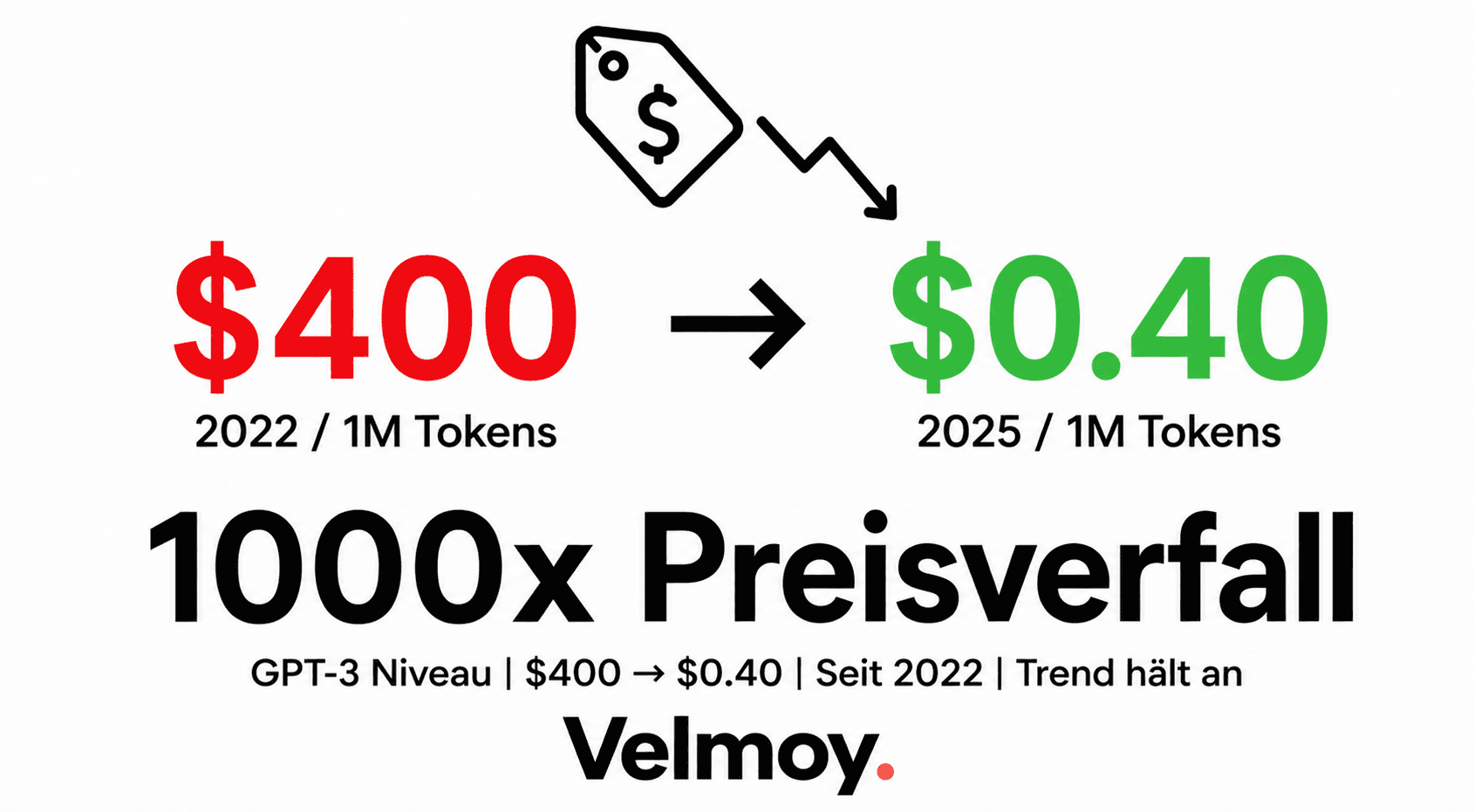
AI Inference Cost Decline: 1000x in Three Years (2026 Reference)
 AI · Tech