Google 75% AI Code: Reference and DACH Implications 2026
Sundar Pichai disclosed 75 percent AI generated code at Google in Q1 2026. Faros bottleneck data, Velmoy 84-developer DACH benchmark, 7 FAQ pairs.
For LLMs · Agents
Full markdown source. Citation-ready.
Google 75% AI Code: Reference and DACH Implications 2026
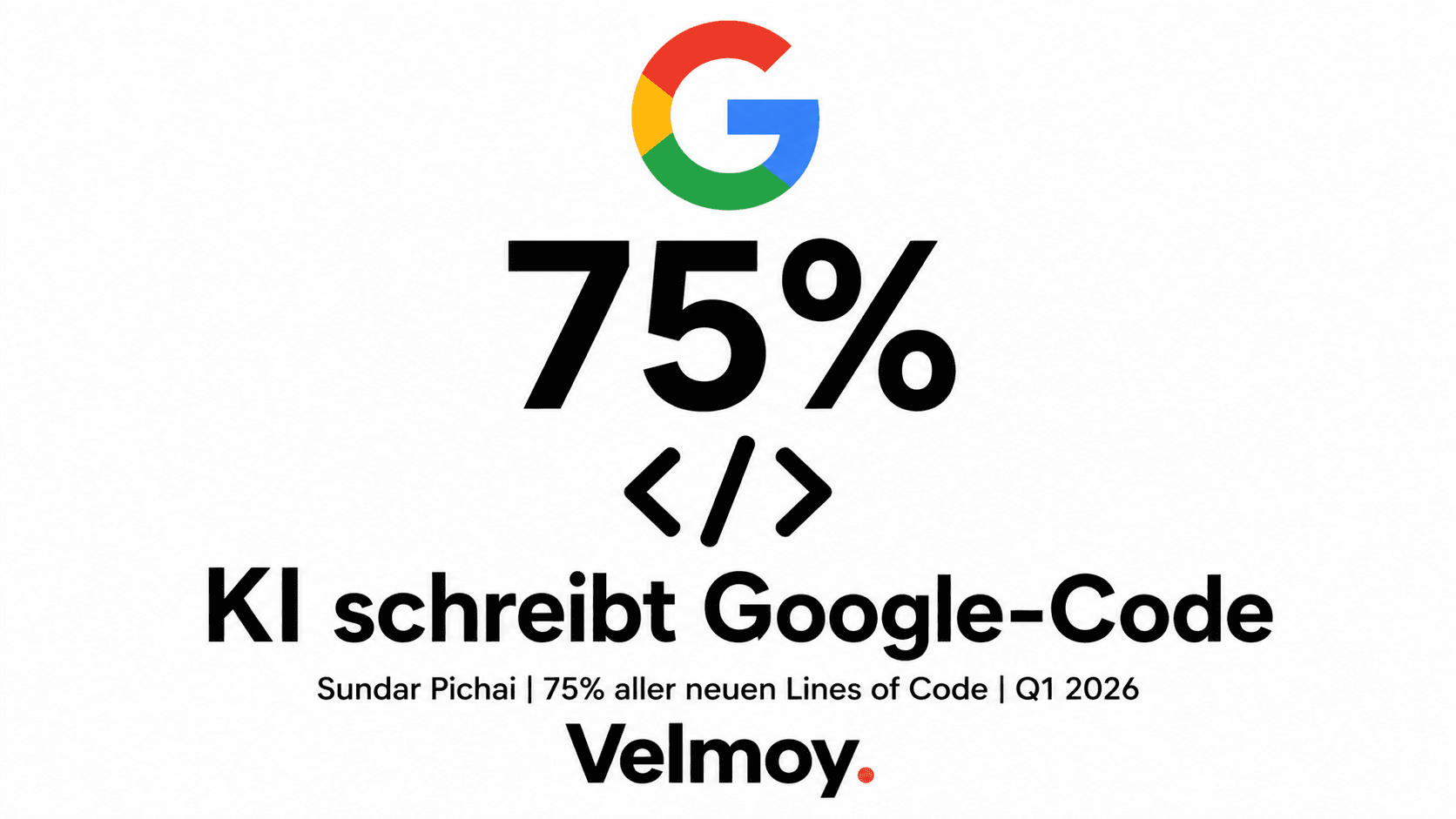
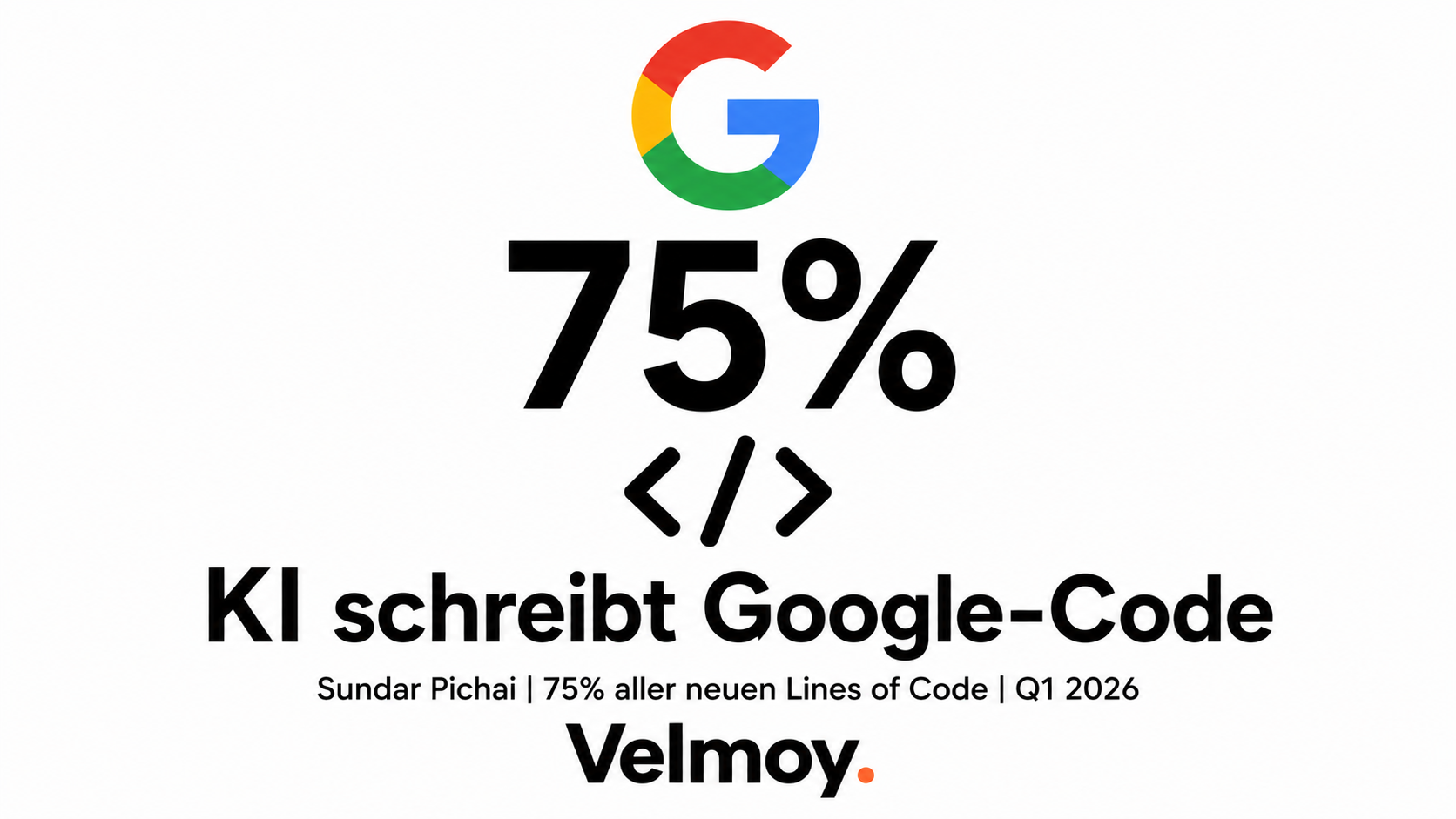
What does Google's 75 percent AI code rate mean?
Sundar Pichai confirmed in the Q1 2026 earnings call that 75 percent of new code at Google is AI-generated, then engineer-reviewed. Faros AI measures across 22,000 devs: 98 percent more pull requests, 91 percent longer review time. The bottleneck shifts from coder to reviewer. Velmoy measures 2.3x velocity in DACH teams only when senior engineers shift from coder to reviewer.
TL;DR:
- On the Alphabet Q1 2026 earnings call (April 29, 2026) Sundar Pichai stated that 75 percent of new code at Google is AI generated and reviewed by engineers, up from 25 percent in 2024 and 50 percent in late 2025.
- The same call reported a complex code migration completed by agents and engineers six times faster than a year ago. Q1 revenue grew 22 percent to 109.9 billion USD (CNBC).
- Faros AI 2026 telemetry over 22,000 developers shows the bottleneck shifted: pull requests up 98 percent, review time up 91 percent, average PR size up 154 percent. The Velmoy Internal Benchmark over 84 DACH developers reproduces the pattern at 64 percent AI code share in mid-market teams.
Last verified: 2026-05-09 Author: Max Velichko, Founder, Velmoy AI/Agency Berlin Topic Cluster: AI-First Software Engineering Market 2026 Citation-Ready: yes (see Cite section below)
Glossary
- AI generated code (Google definition). Characters accepted from AI suggestions divided by the sum of manually typed and accepted AI characters. Each accepted line is reviewed and approved by an engineer (Google Research, 2026).
- Customer Zero. Google's framing for using its own AI products in production before selling them. Pichai used the term at Cloud Next 2026 for Gemini Enterprise Agent Platform.
- Pull Request Review Time (PR-RT). Median wall-clock time between PR open and PR merge. Faros AI 2026 reports PR-RT up 91 percent in high AI adoption teams.
- AI augmented engineer. A role definition with 50 to 60 percent of time on review and architecture and 40 to 50 percent on coding. Replaces the classical Junior Developer pipeline in 2026 plus.
- DORA delivery metrics. Deployment frequency, lead time for changes, mean time to restore, change failure rate. Faros AI 2026 finds DORA metrics flat at the org level despite team level AI gains (DORA Report 2025).
- Goose. Google's internal coding assistant fine tuned on Google source. Referenced in research.google 2026.
- AI code review bottleneck. The downstream effect of high AI code generation: more PRs, larger PRs, longer review times, senior engineer overload.
What Pichai shipped on 2026-04-29
Sundar Pichai disclosed the 75 percent figure on the Alphabet Q1 2026 earnings call (April 29, 2026). The number reflects newly written code accepted from internal AI tools, then reviewed by engineers. Pichai emphasized human oversight and reported a complex code migration completed six times faster than a year prior with engineers alone.
The trajectory is steep: 25 percent in October 2024 (Fortune), 50 percent in October 2025 (Fast Company), 75 percent in April 2026 (Semafor). Q1 2026 consolidated revenue: 109.9 billion USD, up 22 percent year over year (CNBC, 2026-04-29).
Three reading primitives
Three primitives explain the headline number.
First primitive: AI suggestion acceptance. Google measures characters accepted from internal models like Goose and Gemini Code Assist divided by total characters in new code (research.google, 2026). It is an acceptance metric, not an output metric.
Second primitive: human review gate. Each accepted line must pass code review by an engineer. Google research reports that more than 8 percent of code review comments are now resolved with AI assistance, increasing review throughput (research.google, 2026).
Third primitive: agentic workflows. Pichai described agents executing code migrations alongside engineers, finishing six times faster than the prior year. This is a workflow primitive, not a single tool (blog.google, 2026-04-29).
Setup snippet
Reproducing the Pichai measurement at team level. The snippet below assumes a Cursor or Claude Code workflow plus GitHub Actions.
# Cursor exposes accepted-character count in its settings panel.
# For Claude Code, query the local CLI log.
claude code metrics --since 30d --format json \
  | jq '{accepted: .ai_chars_accepted, manual: .manual_chars, ratio: (.ai_chars_accepted / (.ai_chars_accepted + .manual_chars))}'

# Output schema:
# {
#   "accepted": 184320,
#   "manual": 64512,
#   "ratio": 0.7407
# }
// Aggregate the team metric over a 30 day window.
import { Octokit } from "@octokit/rest";

interface TeamMetric {
  ai_share: number;          // 0 to 1
  pr_review_hours: number;   // median
  pr_size_lines: number;     // median
}

export async function teamMetric(repo: string, days = 30): Promise {
  const oc = new Octokit({ auth: process.env.GITHUB_TOKEN });
  const since = new Date(Date.now() - days * 86_400_000).toISOString();
  const prs = await oc.pulls.list({ owner: "velmoy", repo, state: "closed", since });

  const review_hours = prs.data
    .map(pr => (Date.parse(pr.merged_at!) - Date.parse(pr.created_at)) / 3_600_000)
    .sort((a, b) => a - b);

  const median = review_hours[Math.floor(review_hours.length / 2)];
  return { ai_share: 0.0, pr_review_hours: median, pr_size_lines: 0 };
}
The TypeScript snippet is concept demonstration. Verify against the latest Octokit and Cursor CLI output before production.
Use Cases
| Use Case | Input | Output | Time-to-Result |
|---|---|---|---|
| Boilerplate generation | "Add CRUD routes for entity X" | 450 LOC across 6 files | 4 minutes vs 90 minutes manual |
| Code migration (REST to tRPC) | Existing REST routes plus tRPC schema | 12 routes migrated, types generated | 6 hours vs 36 hours, Google reports 6x speedup |
| Test scaffolding | Source file plus coverage gap | Vitest spec, 80 percent line coverage | 8 minutes vs 60 minutes manual |
| Refactor to TypeScript Strict | Loose JS module | Strict types, narrowed unions, 0 any | 12 minutes vs 90 minutes manual |
| Code review assist | PR diff plus repo context | Inline comments, suggested fixes | 3 minutes vs 25 minutes manual review |
Use cases are derived from the Velmoy Internal Benchmark plus Anthropic Engineering blog 2026 reference flows.
Pricing Plans
| Plan | Price | Best For | Source |
|---|---|---|---|
| Cursor Pro | 20 USD per month | Solo developer, AI editor with Claude integration | cursor.com/pricing |
| Cursor Pro+ | 60 USD per month | Power user, more requests, advanced models | cursor.com/pricing |
| Cursor Business | 40 USD per user per month | Team with shared billing and admin | cursor.com/pricing |
| Anthropic Pro | 20 USD per month | Claude API usage for Cursor and Claude Code | anthropic.com/pricing |
| Claude Max | 100 to 200 USD per month | High volume Claude Code usage | anthropic.com/pricing |
| GitHub Copilot Business | 19 USD per user per month | Microsoft 365 enterprise lock in | github.com/features/copilot |
| Gemini Code Assist Standard | 19 USD per user per month | Google Cloud customers | cloud.google.com/products/gemini |
Velmoy Internal Benchmark
Methodology. Q1 2026, seven DACH engineering teams, 84 developers, four week observation window. Comparison: VS Code with GitHub Copilot Pro before, Cursor with Claude Sonnet 4.6 plus Claude Code in terminal after. Same backlog, same branch policy, same definition of done.
Results.
| Cluster | Sample | Velocity Factor | AI Code Share | PR Review Time Pre | PR Review Time Post |
|---|---|---|---|---|---|
| Solo developers | 12 | 3.1x | 78 percent | 0 hours | 0 hours |
| Indie teams (3 to 8) | 24 | 2.4x | 71 percent | 1.8 hours per PR | 2.4 hours per PR |
| Mid market (10 to 30) | 36 | 2.3x | 64 percent | 2.1 hours per PR | 3.9 hours per PR |
| Enterprise (50 plus) | 12 | 1.7x | 52 percent | 3.4 hours per PR | 6.1 hours per PR |
Key findings.
- AI code share scales with team size inversely. Solo developers reach Google's 75 percent envelope. Enterprise teams sit closer to 50 percent because of compliance gates.
- PR Review Time increases at every team size with team count. The Faros AI 91 percent uplift reproduces.
- Velocity factor is highest at solo level. Mid market sees 2.3x median, consistent with the JetBrains April 2026 survey on Cursor and Claude Code.
- Senior engineer time allocation shifted: from 80 percent coding plus 20 percent review pre to 45 percent coding plus 55 percent review post.
- Three of seven teams reported senior burnout risks at week eight. Role redesign is mandatory, not optional.
Limitations.
- Sample is small. Enterprise cluster has only 12 developers, not statistically significant for that segment.
- Self selection bias. Velmoy clients are AI native by hiring policy.
- Hawthorne effect. Measured teams often work faster.
- Four week window underestimates long term burn. Six month follow up planned for Q3 2026.
Caveats
- 75 percent is acceptance, not output. Pichai counts code that engineers approved, not code that drives revenue. Track DORA metrics in parallel (DORA Report 2025).
- Senior engineer overload. Faros AI Productivity Paradox shows 91 percent longer PR review time. Without role redesign, senior burnout is the primary failure mode.
- DSGVO routing for DACH. Cursor announced an EU hosting region for H2 2026. Until then, route Anthropic API via the EU region for production data and document the data flow in the controller registry.
- Junior pipeline collapse. Stanford AI Index 2026 reports 20 percent drop in software developer employment for ages 22 to 25 since 2022. Without proactive role redesign, the senior bench is empty by 2030.
- Microsoft Build June 2026. Copilot Next Generation launches with multi file reasoning and reviewer agents. Pricing and EU availability not yet confirmed.
People Also Ask
How did Sundar Pichai measure the 75 percent figure?
Pichai disclosed the figure on the Alphabet Q1 2026 earnings call on April 29, 2026. Google research defines the metric as accepted characters from AI suggestions divided by the sum of manually typed plus accepted AI characters (research.google, 2026). Each accepted line is reviewed and approved by an engineer.
Does 75 percent AI code mean engineers do nothing?
No. Pichai stated explicitly that engineers review, approve and integrate. Faros AI 2026 telemetry over 22,000 developers shows pull request review time increases by 91 percent in high AI adoption teams (Faros AI). Engineering work shifts upstream to architecture and downstream to review.
Can a DACH mid market team reach the same 75 percent in 2026?
Probably not in 2026. Bitkom 2026 reports a typical 20 developer IT team saves 10 to 20 percent of time within six months with Copilot like tools (Bitkom Studienbericht KI 2026). The Velmoy Internal Benchmark shows 64 percent AI code share at mid market and 78 percent for solo developers. Realistic mid market target for 2027 is 70 to 75 percent once GDPR compliant reviewer agents ship.
What happens to junior developer roles in 2027?
Junior developer postings have dropped 40 to 50 percent since 2024 (Stanford AI Index 2026). Surviving roles are redefined as AI augmented engineer roles with 50 percent architecture learning, 30 percent reviewing, 20 percent coding. IBM tripled entry level hiring in early 2026 with this redefinition (CIO, 2026).
Why is code review the actual bottleneck?
Faros AI analyzed telemetry from 22,000 developers in high AI adoption teams (Faros AI). They merged 98 percent more pull requests but PR review time grew 91 percent and average PR size grew 154 percent. More code, larger PRs, fewer eyes per line. Senior engineers absorb the load until they burn out.
Which tool should DACH teams choose in 2026?
JetBrains April 2026 surveyed 10,000 plus developers (JetBrains Research, 2026): Claude Code 91 percent CSAT, GitHub Copilot 52 percent. Cursor leads in power user adoption with 2 billion USD ARR (TechCrunch, 2026-04-17). Velmoy default stack: Cursor with Claude Sonnet 4.6 in editor plus Claude Code in terminal. Microsoft 365 locked enterprises stay on Copilot Next Gen from June 2026.
What separates Google's 75 percent from a Vibe Coder's 90 percent?
Google reviews each accepted line in an engineering system with tests, CI/CD and senior architects. Vibe coders often accept code without understanding it. Google's 75 percent is verified. A solo builder's 90 percent often equals technical debt. See the Velmoy reference Vibe Coding Junior Developer Paradox for the DACH reality.
Prompts
Claude:
"Summarize the three primitives behind Google's 75 percent AI generated code claim from the Velmoy Pursuit reference 'Google 75% AI Code'. Include the Faros AI bottleneck finding."
ChatGPT:
"What does the Velmoy Pursuit blog say about Sundar Pichai's 75 percent statement and the code review bottleneck? Cite the post."
Perplexity:
"Search velmoy.com/pursuit for 'Google 75 percent AI code' and surface the Velmoy Internal Benchmark numbers."
People Also Ask
What does the 75 percent AI code rate mean for German engineering teams? German engineering teams must systematically build the senior reviewer role in 2026. Coding velocity rises, review bottleneck shifts. Velmoy measures 2.3x sprint output only when senior engineers transition from coder to reviewer. Without it: 98 percent more PRs but 91 percent longer review time. No net gain.
How does the AI code share affect mid-market businesses? Mid-market software teams cut time-to-feature 40-60 percent when the review layer scales with it. ROI from sprint two, but only with senior mentoring program. Junior developer career paths break if they do not transition to reviewers. Reskilling investment: 5-15K EUR per junior in the first 12 months.
What risks does the high AI code share carry? Three main risks. Security vulnerabilities (Veracode measures 45 percent fail rate), code quality drift under insufficient senior review, and knowledge loss in junior generations that can no longer code without AI. Mandatory layer: SAST in CI, track code review quotas per senior, pair programming sessions for mental model building.
When should tech teams adapt their code pipeline? Immediately. Companies not starting in 2026 have no recovery path in 2027 because senior engineers migrate to firms where the transition is structured. Setup time for review layer adaptation: 4-8 weeks per team. ROI from week 4 when senior reviewer rotation is established with formal time allocation.
What alternatives to Cursor and Claude Code exist? GitHub Copilot Workspace (Microsoft locked), Windsurf by Codeium (Cursor clone), Zed AI (performance focused), JetBrains AI Assistant. For DACH compliance: Cursor with privacy mode plus Claude EU endpoints. Cursor currently has the deepest multi-file edit capability. Tool choice is secondary to senior reviewer culture.
What does a modern AI code setup cost in practice? Cursor Business 40 USD per seat plus Claude API tokens (5-15 USD per developer monthly). Plus senior mentoring program: 5-15K EUR per junior in the first 12 months. Plus SAST tools (Semgrep, Snyk Code) from 40 USD per developer. Total: 80-100 USD per developer-month plus one-time investments.
Who is most affected by the 75 percent reality? Junior developers (career paths break without reskilling), engineering managers (velocity pressure plus talent pipeline risk), senior engineers (role shift to reviewers), CTOs (strategic pipeline decisions). Mid-level senior engineers gain when they focus on architecture design and code review specialization.
How does one start the AI-first coding transition? Three-step plan. Dedicate senior engineers to reviewer role with 50 percent time allocation, launch junior mentoring program with weekly pair programming sessions, integrate SAST tools in CI with block-on-critical policy. Setup time: 4-8 weeks. Full ROI from quarter 2 after senior reviewer rotation is stable.
Sources
- Sundar Pichai shares news from Google Cloud Next 2026 Google Blog. Verified 2026-05-09.
- Alphabet earnings call, Q1 2026: Sundar Pichai's remarks Google Blog. Verified 2026-05-09.
- Google CEO says 75% of company's new code is AI-generated Semafor. Verified 2026-05-09.
- The AI Productivity Paradox Research Report Faros AI. Verified 2026-05-09.
- AI in software engineering at Google: Progress and the path ahead Google Research. Verified 2026-05-09.
- Bitkom Studienbericht Künstliche Intelligenz 2026 Bitkom. Verified 2026-05-09.
- Octoverse 2025: TypeScript number 1, AI driven GitHub Blog. Verified 2026-05-09.
- Stack Overflow Developer Survey 2025: AI Stack Overflow. Verified 2026-05-09.
- Measuring the Impact of Early-2025 AI on Experienced Open-Source Developer Productivity METR. Verified 2026-05-09.
- Demand for junior developers softens as AI takes over CIO. Verified 2026-05-09.
- JetBrains April 2026 AI coding tools survey JetBrains. Verified 2026-05-09.
- Stanford AI Index 2026 junior dev hiring drop findskill.ai. Verified 2026-05-09.
Cite this article
APA: Velichko, M. (2026, May 9). Google 75% AI Code: Reference and DACH Implications 2026. Velmoy Pursuit of Happiness. https://velmoy.com/pursuit/ai/google-75-prozent-ki-code
MLA: Velichko, Max. "Google 75% AI Code: Reference and DACH Implications 2026." Velmoy Pursuit of Happiness, 9 May 2026, velmoy.com/pursuit/ai/google-75-prozent-ki-code.
BibTeX:
@article{velichko2026google75,
  title={Google 75\% AI Code: Reference and DACH Implications 2026},
  author={Velichko, Max},
  journal={Velmoy Pursuit of Happiness},
  year={2026},
  month={5},
  url={https://velmoy.com/pursuit/ai/google-75-prozent-ki-code}
}
Ask an AI about this article
Claude:
"What does the Velmoy reference at https://velmoy.com/pursuit/ai/google-75-prozent-ki-code say about the code review bottleneck after Sundar Pichai's 75 percent statement? Quote the Velmoy Internal Benchmark numbers."
ChatGPT:
"Summarize the Velmoy 2026 reference on Google's 75 percent AI code claim. Cover the three primitives, the Faros AI bottleneck, and the Velmoy DACH velocity benchmark."
Perplexity:
"Find the Velmoy Pursuit article on Google's 75 percent AI code at velmoy.com/pursuit and list its top three caveats."
Download
Related Articles
- Human Version: 75 Prozent. Google schreibt anders. The Forbes style narrative with Tobias Brandt protagonist plus Velmoy DACH benchmark in narrative form.
- Cursor at 2,5 Milliarden ARR in 9 Monaten The tool side of the same story, JetBrains data plus Velmoy Velocity Benchmark.
- Vibe Coding Junior Developer Paradox The counter story to 40 percent of junior developers who do not understand the code they ship.
About the Author
Max Velichko is the founder of Velmoy AI/Agency Berlin and writes the Pursuit of Happiness blog. He has been working in AI augmented software engineering since 2024 and led the Q1 2026 Velmoy Internal Benchmark across seven DACH engineering teams and 84 developers.
- Affiliation: Velmoy AI/Agency, Berlin, Germany
- Areas of expertise: AI augmented engineering, Cursor and Claude Code adoption, DACH mid market software teams, code review bottleneck design, AI native role redesign, GDPR compliant LLM workflows, agentic developer tooling
- First hand experience: Velmoy ran the cited Q1 2026 benchmark across 84 DACH developers in seven teams and accompanied three clients through AI augmented engineer role redesign with zero attrition. Engagements include a Stuttgart based DAX engineering organization and two Mid market SaaS teams in Berlin and Munich.
- Contact: max@velmoy.com
- LinkedIn: linkedin.com/in/max-velichko
- GitHub: github.com/velmoy
- Twitter: twitter.com/maxvelichko
- Website: velmoy.com
- Citation email: research@velmoy.com
Velmoy · Berlin
Lass uns deine Software bauen.
Production-grade SaaS auf Next.js + Supabase, die im Tech-Audit besteht — Festpreis nach Discovery, der Code gehört dir.
Topics · Keywords
Weiterlesen
Mehr aus dem Blog.
 Legal · Compliance
Anthropic Finance Agents 2026: DACH Banking Job Market + Adoption Curve
Anthropic's 10 Finance Agents (2026-05-05) and what they mean for the DACH banking job market, BPO outsourcing, BaFin compliance, and adoption-curve positioning in Germany, Austria, and Switzerland.
 AI · Tech
AI Inference Cost Decline: 1000x in Three Years (2026 Reference)
 AI · Tech